
From 2002 to 2009, the company’s factories produced a 2.4-liter Dodge EDV turbo engine that was fitted to charged versions of several models, including the PT Cruiser GT and Neon SRT-4. Under the EDT index, a slightly distorted version of this power unit existed.
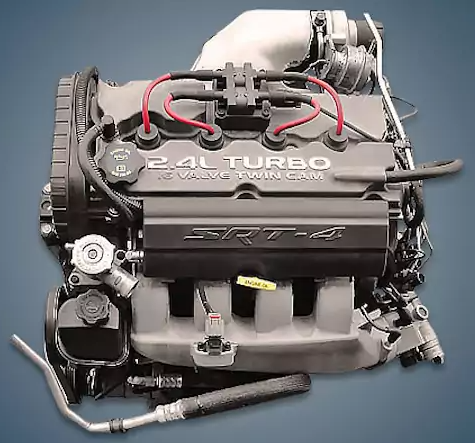
The internal combustion engines EBD, ECB, ECC, ECH, EDT, and EDZ are also part of the Neon series.
The engine was installed on:
- Chrysler PT Cruiser 1 (PT) in 2002 – 2009;
- Dodge Neon 2 (PL) in 2002 – 2005.
Specifications
| Production years | 2002-2009 |
| Displacement, cc | 2429 |
| Fuel system | injector |
| Power output, hp | 215 – 235 |
| Torque output, Nm | 330 – 340 |
| Cylinder block | cast iron R4 |
| Block head | aluminum 16v |
| Cylinder bore, mm | 87.5 |
| Piston stroke, mm | 101 |
| Compression ratio | 8.1 |
| Features | DOHC |
| Hydraulic lifters | yes |
| Timing drive | belt |
| Phase regulator | no |
| Turbocharging | MHI TD04LR |
| Recommended engine oil | 5W-30 |
| Engine oil capacity, liter | 4.7 |
| Fuel type | petrol |
| Euro standards | EURO 3/4 |
| Fuel consumption, L/100 km (for Dodge Neon 2004) — city — highway — combined |
14.0 8.1 10.8 |
| Engine lifespan, km | ~200 000 |
Disadvantages of the EDV engine
Since this motor frequently overheats, it is crucial to keep an eye on the cooling system;
Additionally, this area frequently experiences antifreeze leaks, which makes matters worse;
Every 100,000 kilometers, the timing belt needs to be changed because if it breaks, the valve will bend; poor gasoline causes fuel injectors to clog easily and need to be flushed;
A respectable amount of oil consumption may start to show up after 100–150 thousand kilometers.