
From 1974 to 1990, the 3.0-liter inline 5-cylinder Mercedes OM 617 engine was put together and mounted on well-known models like the W123, W126, and Geléewagen SUV. This diesel unit has undergone numerous modifications as a result of ongoing upgrades.
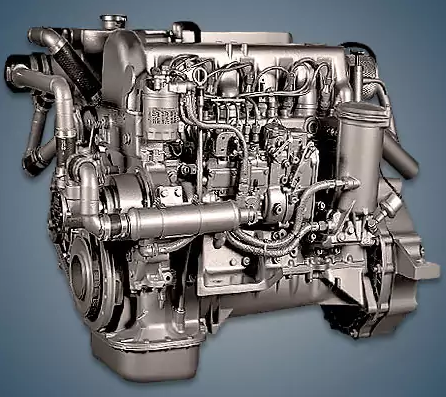
OM617, OM602, OM605, OM612, and OM647 are members of the diesel R5-family.
Based on the OM616 4-cylinder diesel engine, a comparable 5-cylinder engine was developed in 1974. This pre-chamber diesel power unit underwent atmospheric modification initially. A single camshaft and an in-line Bosch M injection pump are both rotated by a two-row timing chain, a cast-iron 10-valve cylinder head without hydraulic lifters, and the same cast-iron cylinder block. 1979 saw the introduction of a new cylinder head, an increase in the compression ratio, and an increase in power from 80 to 88 horsepower.
The American version of the W116 sedan made its debut with the Garrett TB03 turbocharged diesel in 1977. It was also updated in 1979, and the new unit’s power went from 111 to 121 horsepower. The most potent version of the engine, with 125 horsepower and 250 Nm, debuted in 1982.
One of the main factors contributing to Mercedes’ appeal in North America during the 1980s was the OM617 engine, which is regarded as one of the most dependable and frequently reaches over 1,000,000 kilometers.
The first diesel engine that could be used in S-class and mid-range vehicles was the turbocharged engine. Daimler-Benz was eager to fulfill the US government’s fuel consumption goals. The first (S-Class W 116, Coupe C 123) and second body versions (S-Class 126 series) of the 300 SD (S-Class Diesel) and 300 CD (Coupe Diesel) models looked like this.
Specifications
| Production years | 1974-1990 |
| Displacement, cc | 3005 (OM 617 D 30 (1974), OM 617 D 30 A (1977) 2998 (OM 617 D 30 (1979), OM 617 D 30 A (1979), OM 617 D 30 A (1982) |
| Fuel system | vortex chamber |
| Power output, hp | 80 (D30 (1974) 88 (D30A (1977) 111 (D30 (1979) 121 (D30A (1979) 125 (D30A (1982) |
| Torque output, Nm | 172 (D30 (1974) 172 (D30A (1977) 228 (D30 (1979) 230 (D30A (1979) 250 (D30A (1982) |
| Cylinder block | cast iron R5 |
| Block head | cast iron 10v |
| Cylinder bore, mm | 91 (D30 (1974), D30A (1977) 90.9 (D30 (1979), D30A (1979), D30A (1982) |
| Piston stroke, mm | 92.4 |
| Compression ratio | 21.0 (D30 (1974) 21.5 (D30A (1977), D30 (1979), D30A (1979), D30A (1982) |
| Hydraulic lifters | no |
| Timing drive | double-row chain |
| Recommended engine oil | 10W-40, MB 228.1/229.1 |
| Engine oil capacity, liter | 6.5 |
| Fuel type | diesel |
| Euro standards | EURO 0 |
| Fuel consumption, L/100 km (for Mercedes 300 SD 1978) — city — highway — combined |
11.2 8.7 9.9 |
| Engine lifespan, km | ~1 000 000 |
| Weight, kg | 265 |
The engine was installed on:
- Mercedes E-Class W114 in 1974 – 1976; E-Class W123 in 1976 – 1986;
- Mercedes G-Class W460 in 1979 – 1990;
- Mercedes S-Class W116 in 1977 – 1980; S-Class W126 in 1979 – 1985;
- Mercedes T1-Series W601 in 1981 – 1988.
Disadvantages of the OM617 engine
Up until 1979, diesel engines frequently had crankshaft bursts and block cracks near the fifth cylinder. A constructive calculation error was made, and it was fixed a little later.
After a lengthy drive at a high speed, the turbine does not have a lot of resources and cannot withstand the engine being turned off right away. In general, installing a turbo timer is preferable.
This motor has a double-row timing chain that is strong but not the strongest. Along with dampers and stars, it needs to be replaced roughly every 200–250 thousand kilometers.
Additionally, the owners of these diesel engines report frequent lubricant leaks, particularly through the crankshaft rear oil seal, which is packed here, as well as extremely noisy operation and strong vibrations. It should be mentioned that the booster pump frequently leaks and is not the most dependable.