
Only two models—the E-class in the rear of the W210 and the S-class in the rear of the W220—were equipped with the 3.2-liter inline 6-cylinder Mercedes OM613 engine, which was built between 1999 and 2003. With 197 horsepower and 470 Nm, this power unit was available as a single 320 CDI modification.
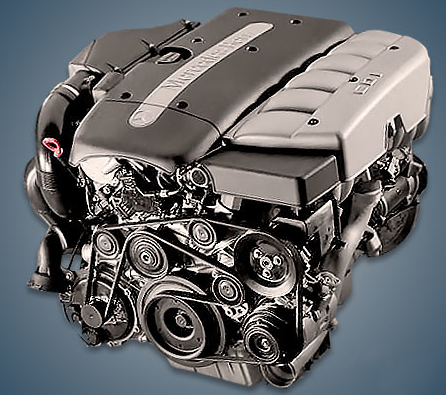
The diesel R6-family comprises OM603, OM606, OM613, OM648, and OM656.
The engine features two camshafts, an oxidation catalytic converter, exhaust gas recirculation, and four valves per cylinder. This engine produces 197 horsepower and is identified by the designation “320 CDI.” This diesel is well known for its extraordinary endurance. Serious problems with this engine are rare, even though the more parts there are, the more likely it is to break. The strength of the cylinder-piston group is very high. A dual-mass flywheel and a turbine can typically endure several hundred thousand kilometers.
Specifications
| Production years | 1999-2003 |
| Displacement, cc | 3222 |
| Fuel system | Common Rail |
| Power output, hp | 197 |
| Torque output, Nm | 470 |
| Cylinder block | cast iron R6 |
| Block head | aluminum 24v |
| Cylinder bore, mm | 88 |
| Piston stroke, mm | 88.3 |
| Compression ratio | 18.0 |
| Features | no |
| Hydraulic lifters | yes |
| Timing drive | chain |
| Phase regulator | no |
| Turbocharging | yes |
| Recommended engine oil | 5W-30 |
| Engine oil capacity, liter | 7.5 |
| Fuel type | diesel |
| Euro standards | EURO 3/4 |
| Fuel consumption, L/100 km (for Mercedes E 320 CDI 2001) — city — highway — combined |
11.1 5.9 7.8 |
| Engine lifespan, km | ~400 000 |
| Weight, kg | 245 |
The engine was installed on:
- Mercedes E-Class W210 in 1999 – 2003;
- Mercedes S-Class W220 in 1999 – 2003.
Disadvantages of the OM613 engine
This diesel engine’s known issues are all connected to Common Rail fuel equipment.
Both the fuel shut-off valve and the fuel rail pressure sensor frequently malfunction.
The system is continuously aired because the quick couplings are drying out.
Accelerated carbon formation results from refractory washer burnout beneath the nozzles.
The camshaft and crankshaft position sensors are the electrical weak point.