
Only the E-Class in the body of the W211 and the redesigned S-Class in the body of the W220 were equipped with the 3.2-liter 6-cylinder inline Mercedes OM648, which was put together between 2002 and 2006. A modification with a power reduction to 177 horsepower was available in addition to the standard version of 204 horsepower.
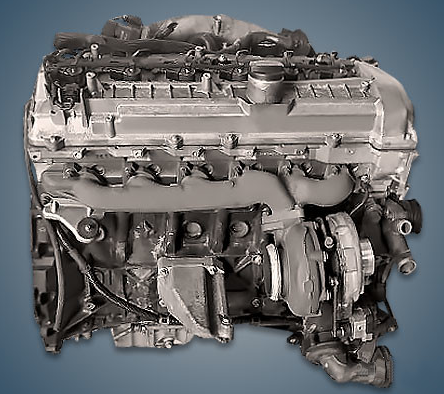
OM603, OM606, OM613, OM648, and OM656 are members of the diesel R6 family.
Two versions of the motor were manufactured: 648.960, which was installed on S320CDI, and 648.961, which was installed on E320CDI and E280CDI. Additionally, the working volume—3222 cc—was the same everywhere.
The engine is internally designated as OM 648 DE 32 LA. The OM648 has a working volume of 3222 cc and produces 204 horsepower for the 320CDI version and 177 horsepower for the 280CDI version. The maximum power is attained at a speed of 4200 rpm in both scenarios. In the first scenario, the maximum torque is 500 Nm at 1800 rpm, and in the second, it is 425 Nm at 1800–2500 rpm.
Specifications
| Production years | 2002-2006 |
| Displacement, cc | 3222 |
| Fuel system | Common Rail |
| Power output, hp | 177 (OM 648 DE 32 LA red or 280 CDI) 204 (OM 648 DE 32 LA or 320 CDI) |
| Torque output, Nm | 425 (OM 648 DE 32 LA red or 280 CDI) 500 (OM 648 DE 32 LA or 320 CDI) |
| Cylinder block | cast iron R6 |
| Block head | aluminum 24v |
| Cylinder bore, mm | 88 |
| Piston stroke, mm | 88.3 |
| Compression ratio | 18.0 |
| Features | DOHC |
| Hydraulic lifters | yes |
| Timing drive | chain |
| Phase regulator | no |
| Turbocharging | VGT |
| Recommended engine oil | 5W-30 |
| Engine oil capacity, liter | 7.5 |
| Fuel type | diesel |
| Euro standards | EURO 4 |
| CO2 emission, g/km | 183 – 204 |
| Fuel consumption, L/100 km (for Mercedes S 320 CDI 2004) — city — highway — combined |
11.0 5.8 7.7 |
| Engine lifespan, km | ~400 000 |
| Weight, kg | 240 |
The engine was installed on:
- Mercedes E-Class W211 in 2002 – 2006;
- Mercedes S-Class W220 in 2002 – 2006.
How the engine works
A VGT or VNT turbocharger powers the engines. The maximum boost pressure is 1600 bar. Motors have two camshafts, and a timing chain is used to drive them. Each cylinder has four valves that can be adjusted using pushers. An electronically operated EGR valve is present. The fuel supply is metered, and the control unit also manages the fuel pump.
Pre-injection refers to the burning of a tiny amount of fuel prior to the main process. This facilitates the heating of the chamber, which helps the motor warm up and start quickly. It goes without saying that the pressure parameter and temperature regime are better preserved. Some versions of these engines have a balance shaft that rotates faster in opposition to the crankshaft.
Disadvantages of the OM648 engine
The common rail fuel system’s components are the primary cause of diesel issues; the fuel shut-off valve and fuel rail pressure sensor frequently malfunction; the engine rapidly cokes due to the burnout of the refractory washers beneath the injectors; the breakdown of plastic quick-release devices is typically the cause of airing the system; and the variable intake manifold flaps frequently wedge because of carbon deposits.