
From 1984 to 1997, Mercedes OM603 6-cylinder engines with 3.0 and 3.5 liters were manufactured and fitted to several of the German company’s well-known models, including the W124, W126, and W140. There were two turbocharged and atmospheric versions of this diesel engine available.
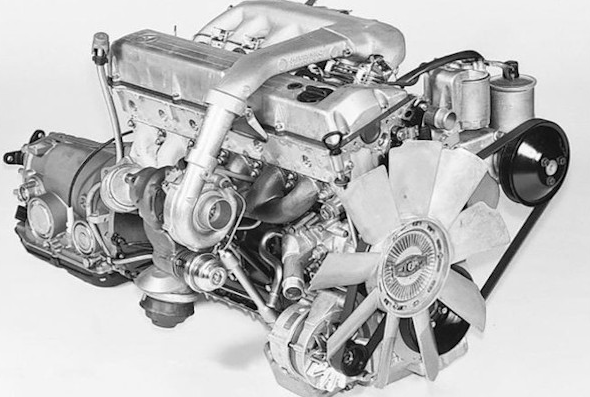
The diesel R6-family consists of OM603, OM606, OM613, OM648, and OM656.
Specifications
| Production years | 1984-1997 |
| Displacement, cc | 2996 (OM 603 D 30 or 300D, OM 603 D 30 A or 300TD) 3449 (OM 603 D 35 A or 350SD) |
| Fuel system | prechamber |
| Power output, hp | 109 – 113 (D30) 143 – 150 (D30A) 136 – 150 (D35A) |
| Torque output, Nm | 185 – 191 (D30) 267 – 273 (D30A) 305 – 310 (D35A) |
| Cylinder block | cast iron R6 |
| Block head | aluminum 12v |
| Cylinder bore, mm | 87 (D30, D30A) 92.4 (D35A) |
| Piston stroke, mm | 84 (D30, D30A) 89 (D35A) |
| Compression ratio | 22.0 |
| Features | no |
| Hydraulic lifters | yes |
| Timing drive | chain |
| Phase regulator | no |
| Turbocharging | no (D30) KKK K24 (D30A, D35A) |
| Recommended engine oil | 5W-40 |
| Engine oil capacity, liter | 7.5 |
| Fuel type | diesel |
| Euro standards | EURO 1 |
| Fuel consumption, L/100 km (for Mercedes E 300 TD 1994) — city — highway — combined |
9.3 6.2 7.9 |
| Engine lifespan, km | ~450 000 |
| Weight, kg | 235 |
The engine was installed on:
- Mercedes E-Class W124 in 1984 – 1995;
- Mercedes G-Class W463 in 1990 – 1997;
- Mercedes S-Class W126 in 1985 – 1991; S-Class W140 in 1992 – 1996.
Disadvantages of the OM603 engine
The resource of its pillows is impacted by this diesel unit’s high vibroload;
The timing chain has a maximum length of 250,000 kilometers, and you will need to replace the block head if it breaks;
The cylinder head gasket frequently bursts due to inexpensive or outdated antifreeze or water in general;
Low-quality oil terrifies hydraulic lifters, which can travel up to 80,000 kilometers;
The vacuum injection pump control system is typically linked to the remaining motor issues.
Modifications OM603
| Modifications | Power, kW (hp) | Torque output, Nm |
| OM603.912 | 81 (109) at 4600 rpm | 191 at 2800 – 3050 rpm |
| 84 (113) at 4600 rpm | 185 at 2800 rpm | |
| OM603.960 and OM603.963 (4Matic) | 106 (143) at 4600 rpm | 267 at 2400 rpm |
| 108 (147) at 4600 rpm | 273 at 2400 rpm | |
| OM603.960 | 106 (143) at 4600 rpm | 267 at 2400 rpm |
| 108 (147) at 4600 rpm | 273 at 2400 rpm | |
| OM603.961 | 110 (148) at 4600 rpm | 273 at 2400 rpm |
| OM603.97x | 100 (136) at 4000 rpm | 310 at 2000 rpm |
| OM603.97x | 111 (150) at 4000 rpm | 310 at 2000 rpm |
Six-cylinder engines with an aluminum cylinder head and steel blocks make up the 603rd series. They also have hydraulic pushers, a dependable injection pump, and other cutting-edge features. The engineers focused particularly on controlling emissions when creating OM 603; these enhanced models enable a 40% reduction in exhaust smoke.
A duplex chain from the crankshaft powers the camshaft and injection pump. The oil pump is powered by a different single-row chain. Hydraulic tappets are used by the camshaft to operate the valves. The valve is automatically adjusted.
The pre-combustion chamber receives an injection of fuel. The fuel lift pump is mounted on the side of the Bosch M injection pump, which has mechanical and vacuum control and is lubricated by a connection to the engine oil circulation. The glow plugs do the preheating on their own.
A diesel particulate filter has been developed as a result of the US market’s stricter emission regulations. The heat from them caused the aluminum cylinder heads to fail because they were mounted on the cylinder head (modern ones are installed further), and the turbocharger could be harmed by debris from the filters.
Strong vibrations are another common issue with the Mercedes OM603 engine. The crankcase bolts and screws become loose as a result. The latter eventually cause oil starvation, bearing damage, and broken block rods by getting into the oil pump or clogging the channels.