
Since 2015, a series of 3.0-liter, six-cylinder BMW B58B30 engines have been assembled in Munich and installed in charged versions of the German company’s all-wheel drive and rear-wheel drive models. These engines come in two generations, and the S58 sports unit line was developed based on them.
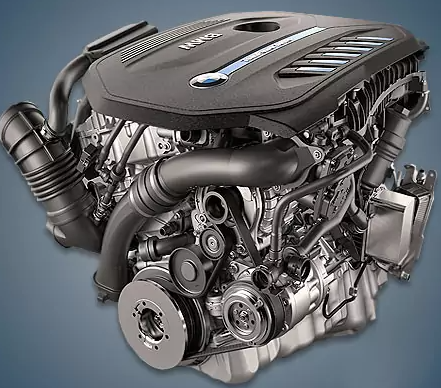
Vanos phase shifters on two camshafts, an aluminum 24-valve cylinder head with hydraulic lifters, a direct fuel injection system, a Valvetronic system, a timing chain drive, and an aluminum block with plasma-sprayed steel on the cylinder walls are all features of B58 engines. A Mahle/Bosch twin-scroll turbocharger with an intercooler provides supercharging for these engines. It’s also important to note that this unit lacks balancing shafts in contrast to the B38 and B48 models.
An updated version, referred to as B58B30TU in the technical literature, was released in 2018. A lightweight crankshaft, a new injection system with pressure raised from 200 to 350 bar, an exhaust manifold integrated into the block head, and a streamlined timing drive with one chain rather than two are what set this power unit apart. Consequently, the weight dropped by 6 kg.
These motors come in three families, with B58B30M1 and B58B30O1 being referred to as B58B30TU.
B58B30M0 (326 – 340 hp / 450 – 500 Nm) engine was installed on:
- BMW 1-Series F20 in 2016 – 2019;
- BMW 2-Series F22 in 2016 – 2021;
- BMW 3-Series F30 in 2015 – 2018; 3-Series F34 in 2016 – 2020;
- BMW 4-Series F32 in 2016 – 2021;
- BMW 5-Series G30 in 2017 – 2020;
- BMW 6-Series G32 in 2017 – 2020;
- BMW 7-Series G11 in 2015 – 2018.
B58B30M1 (333 – 340 hp / 450 – 500 Nm) engine was installed on:
- BMW 5-Series G30 since 2020;
- BMW 6-Series G32 since 2020;
- BMW 8-Series G15 since 2019;
- BMW X5 G05 since 2018;
- BMW X6 G06 since 2019;
- BMW X7 G07 since 2019;
- BMW Z4 G29 since 2019.
B58B30O1 (360 – 374 hp / 500 Nm) engine was installed on:
- BMW 2-Series G42 since 2021;
- BMW 3-Series G20 since 2019;
- BMW 4-Series G22 since 2020;
- BMW X3 G01 since 2018;
- BMW X4 G02 since 2018.
Specifications
| Production years | since 2015 |
| Displacement, cc | 2998 |
| Fuel system | direct injection |
| Power output, hp | 326 – 388 |
| Torque output, Nm | 450 – 500 |
| Cylinder block | aluminum R6 |
| Block head | aluminum 24v |
| Cylinder bore, mm | 82 |
| Piston stroke, mm | 94.6 |
| Compression ratio | 11.0 |
| Features | Valvetronic |
| Hydraulic lifters | yes |
| Timing drive | chain |
| Phase regulator | Vanos on two camshafts |
| Turbocharging | Twin-scroll Mahle/Bosch turbocharger with intercooler |
| Fuel type | petrol |
| Euro standards | EURO 6 |
| Engine lifespan, km | ~300 000 |
| Weight, kg | 139 |
Disadvantages of the B58B30 engine
A drop in the coolant level is the main cause of complaints on the specialized forums. Although the precise cause is unknown, changing the expansion tank cap can occasionally be helpful.
The engine is fairly hot and frequently blows head gaskets. Usually, smoke and a potent smell of burnt oil emerge right away.
Because of carbon buildup on the intake valves, B58 engines frequently experience floating engine speeds, just like the majority of gasoline direct injection engines.
The Vanos phase shifters, the canister valve, and the oil filter—which breaks apart when replaced and is difficult to obtain—are the less common issues here.