
Since 2013, vehicles with front-wheel drive (B38A15), rear-wheel drive (B38B15), and hybrid vehicles (B38K15) have been equipped with the 1.5-liter BMW B38 3-cylinder engine series. Additionally, the 1.2-liter B38A12A and 1.5-liter B38A15A units are installed on the Mini.
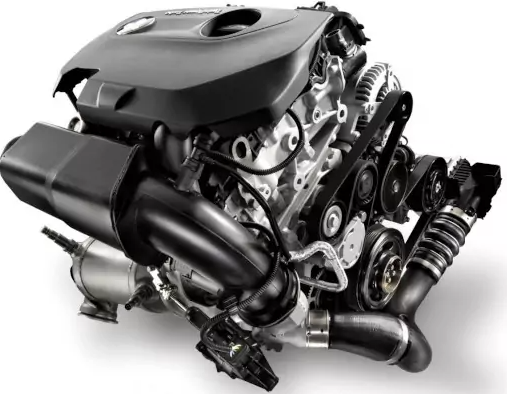
Conventional modifications quickly followed the introduction of B38 gasoline engines as part of the i8 coupe hybrid power plant. Vanos phase shifters on both camshafts, a Valvetronic system, a timing chain drive, an aluminum block with plasma-sprayed steel and a closed jacket, and an aluminum 12-valve cylinder head with hydraulic lifters and direct fuel injection are all part of the design. One water-cooled Continental turbocharger powers the engine. Additionally, a Bosch MEVD 17.2.3 control unit and a balancing shaft should be mentioned.
B38A15U0: 102 hp, 180 Nm. The engine was installed on:
- BMW 2-Series F45 in 2015 – 2018;
- BMW 2-Series F46 in 2015 – 2018.
B38A15U1: 109 hp, 190 Nm. The engine was installed on:
- BMW 1-Series F40 since 2020;
- BMW 2-Series F45 in 2018 – 2021; 2-Series F46 since 2018.
B38A15M0: 136 hp, 220Nm. The engine was installed on:
- BMW 2-Series F45 in 2014 – 2018; 2-Series F46 in 2015 – 2018;
- BMW X1 F48 in 2015 – 2017.
B38A15M1: 140 hp, 220 Nm. The engine was installed on:
- BMW 1-Series F40 since 2019;
- BMW 2-Series F44 since 2020; 2-Series F45 in 2018 – 2021; 2-Series F46 since 2018;
- BMW X1 F48 since 2017;
- BMW X2 F39 since 2018.
B38B15U0: 109 hp, 180 Nm. The engine was installed on:
- BMW 1-Series F20 in 2015 – 2019.
B38B15M0: 136 hp, 220 Nm. The engine was installed on:
- BMW 1-Series F20 in 2015 – 2019;
- BMW 2-Series F22 in 2015 – 2021;
- BMW 3-Series F30 in 2015 – 2018.
B38K15T0: 231 hp, 320 Nm. The engine was installed on:
- BMW i8 L12 in 2013 – 2020;
- BMW i8 L15 in 2017 – 2020.
Specifications
| Production years | since 2013 |
| Displacement, cc | 1499 |
| Fuel system | direct injection |
| Power output, hp | 102 – 140 231 (hybrid version) |
| Torque output, Nm | 180 – 220 320 (hybrid version) |
| Cylinder block | aluminum R3 |
| Block head | aluminum 12v |
| Cylinder bore, mm | 82 |
| Piston stroke, mm | 94.6 |
| Compression ratio | 11.0 9.5 (hybrid version) |
| Features | Valvetronic |
| Hydraulic lifters | yes |
| Timing drive | chain |
| Phase regulator | Vanos |
| Turbocharging | yes |
| Recommended engine oil | 0W-30, 0W-40, 5W-30, 5W-40 |
| Engine oil capacity, liter | 4.25 |
| Fuel type | petrol |
| Euro standards | EURO 6 |
| Fuel consumption, L/100 km (for 318i F30) — city — highway — combined |
6.7 4.6 5.4 |
| Engine lifespan, km | ~300 000 |
Disadvantages of the B38B15 / B38A15 engine
Up until 2015, engines had excessive crankshaft axial clearance, and at 50,000 kilometers, the thrust bearing failed. After that, the design was completed.
This water-cooled turbine’s aluminum casing, which is integral to the exhaust manifold, cracks due to overheating, causing antifreeze to leak.
The intake valves are overgrown with soot, as is the case with all engines that use direct fuel injection. This causes the power unit to operate unsteadily and the rpm to float.
Not the most robust catalyst and adsorber valve are further drawbacks. Additionally, VANOS and Valvetronic system failures are common at high mileage.