
Overview & Design Features
The Cadillac GM V-8 429 engine, often referred to simply as the “Cadillac 429,” represents a significant chapter in the lineage of Cadillac’s exclusive V8 powerplants. Introduced for the 1964 model year, this 429 cubic inch (7.0-liter) engine was developed by Cadillac for its luxury vehicles, replacing the venerable 390 cubic inch unit. Engineered during an era when smooth power delivery and robust construction were paramount for luxury automobiles, the 429 cubic inch V8 became known for its impressive torque output, quiet operation, and reliability, underpinning Cadillac’s reputation for opulent performance throughout its production run from 1964 to 1967.
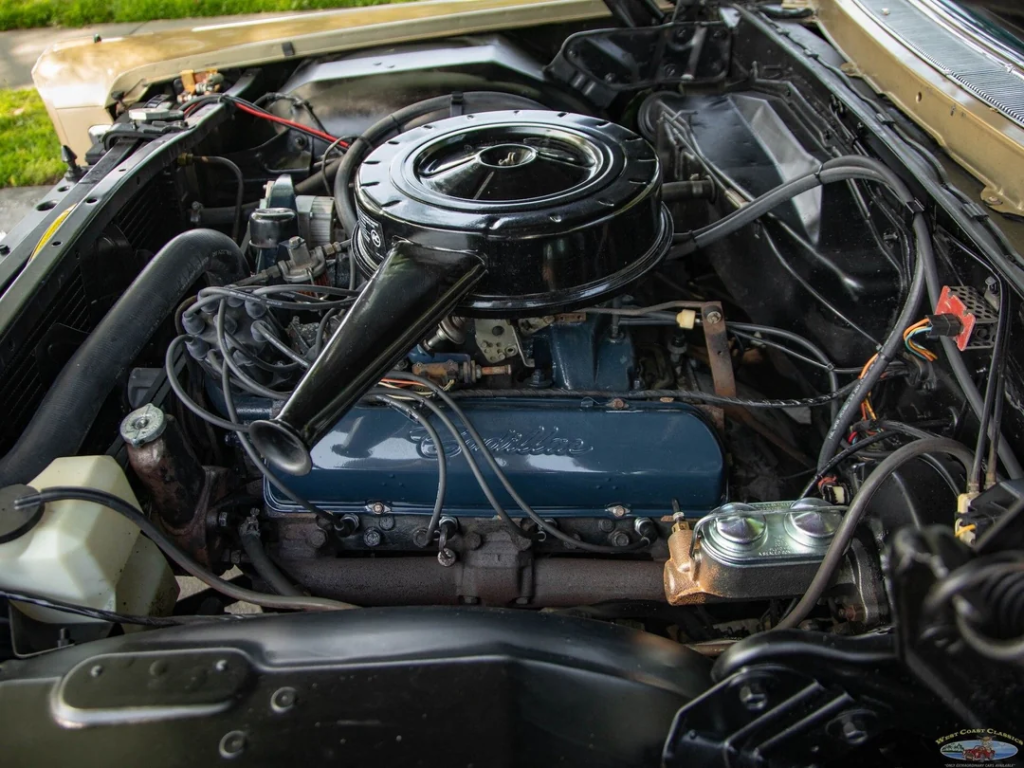
This engine utilizes a conventional yet sturdy overhead valve (OHV) pushrod architecture, common for American V8s of the period. Its core design features a robust cast iron cylinder block and matching cast iron cylinder heads, contributing to its durability and thermal stability. Fuel delivery was managed through a single 4-barrel carburetor, typically a Rochester Quadrajet or a Carter AFB, chosen for its ability to provide ample fuel flow for performance while maintaining drivability. The valvetrain employs hydraulic lifters, ensuring quiet operation and reducing maintenance requirements. There were no advanced variable valve timing or direct injection systems, reflecting the automotive technology of the mid-1960s, instead focusing on proven, durable mechanical designs.
The Cadillac 429 V8 was exclusively deployed across Cadillac’s luxury model range during its production years. It powered various trims of the Cadillac DeVille, including sedans, coupes, and convertibles, from 1964 to 1967. It was also the standard engine for the Cadillac Calais, the upscale Eldorado models, and the prestigious Fleetwood series, including the 60 Special and the 75 Limousine, ensuring consistent, powerful performance across the marque’s most demanding applications until its replacement by the larger 472 cubic inch engine in 1968.
Technical Specifications
| Specification | Value |
|---|---|
| Displacement (cc) | 7030 cc (429 cu in) |
| Max Power (hp (kW) @ RPM) | 340 hp (253 kW) @ 4600 RPM |
| Max Torque (Nm (kg*m) @ RPM) | 651 Nm (66.4 kg*m) @ 3000 RPM |
| Fuel Type | Gasoline (Premium recommended for optimal performance) |
| Fuel Consumption (l/100 km) | Highly dependent on vehicle weight and driving conditions; typically 20-30 l/100 km |
| Engine Type | 90-degree V8 |
| Compression Ratio | 10.5:1 (varied slightly by year/application) |
| Cylinder Bore (mm) | 104.775 mm (4.125 inches) |
| Piston Stroke (mm) | 101.6 mm (4.00 inches) |
| Valvetrain | OHV (Overhead Valve), Pushrod, Hydraulic Lifters |
| Valves per Cylinder | 2 (1 intake, 1 exhaust) |
| Additional Info | Cast iron block and heads, Single 4-barrel carburetor (Rochester Quadrajet or Carter AFB) |
Common Problems & Reliability
- Oil Consumption: As with many engines of its vintage, high-mileage 429s can exhibit increased oil consumption. This is frequently attributed to worn valve guides and seals or fatigued piston rings. While not always indicative of impending catastrophic failure, monitoring oil levels diligently is essential.
- Carburetor Wear and Tuning: The factory 4-barrel carburetors are susceptible to wear over decades of use, leading to issues such as fuel leaks, hard starting, rough idle, and poor fuel economy. Vacuum leaks in associated lines can exacerbate these problems. Routine inspection and rebuilding are often necessary for optimal performance.
- Timing Chain Stretch: While the 429’s timing chain is generally durable, the nylon or plastic-coated cam gears used in some original installations can degrade over time, leading to chain slack and incorrect valve timing. This can manifest as reduced power and poor fuel economy, and in severe cases, engine noise.
The Cadillac 429 V8 is renowned for its inherent robustness, largely due to its heavy-duty cast iron construction. With diligent maintenance and proper care, these engines are capable of delivering a realistic service life of 150,000 to 200,000 miles (240,000 to 320,000 km) before requiring a major overhaul, underscoring its reputation for longevity.
Maintenance Tips & Service Schedule
- Engine Oil & Filter: Change engine oil and filter every 3,000 miles (5,000 km) or every 6 months, whichever comes first. Use a high-quality motor oil with a viscosity of 10W-30 or 15W-40. For engines with original flat tappet camshafts, consider oils with higher zinc (ZDDP) content to prevent premature wear.
- Spark Plugs: Inspect and replace spark plugs every 15,000-20,000 miles (24,000-32,000 km) to maintain efficient combustion and ignition system reliability.
- Coolant Flush: Perform a cooling system flush and refill with fresh 50/50 ethylene glycol coolant every 2 years or 30,000 miles (48,000 km). This prevents corrosion and maintains optimal engine temperature regulation.
- Carburetor Service: Have the carburetor inspected annually. A rebuild may be necessary every 50,000 miles (80,000 km) or if performance issues like erratic idle, poor acceleration, or hard starting become apparent.
- Ignition System: For original breaker point ignition systems, inspect points, condenser, rotor, and distributor cap every 10,000 miles (16,000 km) and replace as needed. Vehicles converted to electronic ignition will require less frequent attention.
- Timing Chain Inspection: At higher mileages, particularly beyond 100,000 miles (160,000 km), it is prudent to inspect the timing chain and gears for excessive slack or wear, especially if a clattering noise is detected from the front of the engine. Replacement of the timing set, especially with metal cam gears, is a wise preventative measure.
Conclusion
The Cadillac GM V-8 429 engine stands as a testament to American automotive engineering of the mid-20th century. Its design prioritizes robust construction, smooth power delivery, and adequate performance for the luxury vehicles it powered. For a used vehicle buyer seeking a classic Cadillac from the 1964-1967 era, the 429 engine represents a safe and generally reliable choice. Its mechanical simplicity makes it relatively straightforward to maintain and repair for those familiar with vintage automotive technology. While not offering modern fuel efficiency, its inherent durability, readily available parts, and strong torque output make it a highly desirable and enduring powerplant for enthusiasts and restorers alike, ensuring many more years of luxurious motoring with proper care.