
The third generation Focus for the North American and Russian markets is equipped with the 2.0-liter Ford XQDA or 2.0 Duratec SCi TI-VCT engine, which has only been manufactured since 2010. Even with a direct injection system, the engine typically doesn’t digest very good fuel.
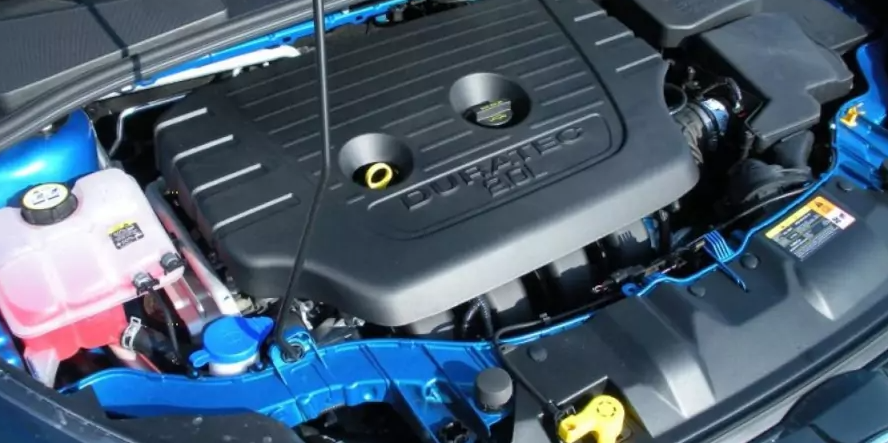
DURATEC HE family:
1.8 L – CFBA, CHBA, QQDB;
2.0 L – AODA, AOWA, CJBA, XQDA;
2.3 L – SEWA, SEBA;
2.5 L – YTMA.
The engine was installed on:
- Ford Focus Mk3 in 2011 – 2018.
Specifications
| Production years | since 2010 |
| Displacement, cc | 1999 |
| Fuel system | direct injection |
| Power output, hp | 150 |
| Torque output, Nm | 202 |
| Cylinder block | aluminum R4 |
| Block head | aluminum 16v |
| Cylinder bore, mm | 87.5 |
| Piston stroke, mm | 83.1 |
| Compression ratio | 12.0 |
| Features | no |
| Hydraulic lifters | no |
| Timing drive | chain |
| Phase regulator | Ti-VCT |
| Turbocharging | no |
| Recommended engine oil | 5W-30 |
| Engine oil capacity, liter | 4.3 |
| Fuel type | petrol |
| Euro standards | EURO 5 |
| Fuel consumption, L/100 km (for Ford Focus 2012) — city — highway — combined |
9.6 5.0 6.7 |
| Engine lifespan, km | ~300 000 |
| Weight, kg | 109 |
Disadvantages of the XQDA engine
Here, the direct fuel injection system is incredibly dependable and rarely causes issues;
Oil consumption typically manifests after 100–150 thousand kilometers as a result of stuck rings;
The timing chain is frequently pulled out and needs to be replaced closer to 200,000 kilometers;
The cylinder head frequently cracks during extended runs, causing oil to seep into the antifreeze. It’s also important to note the limited selection and expensive cost of spare parts for this engine.