
Overview & Design Features
The Infiniti V9X engine represents Nissan’s significant venture into the premium diesel segment, developed as part of the Renault-Nissan Alliance. Introduced in 2010, this 3.0-liter (2,993 cc) V6 turbodiesel engine was engineered to deliver a blend of robust torque, respectable fuel economy, and refined performance, primarily targeting European markets for Infiniti’s luxury crossover and sedan lineups.
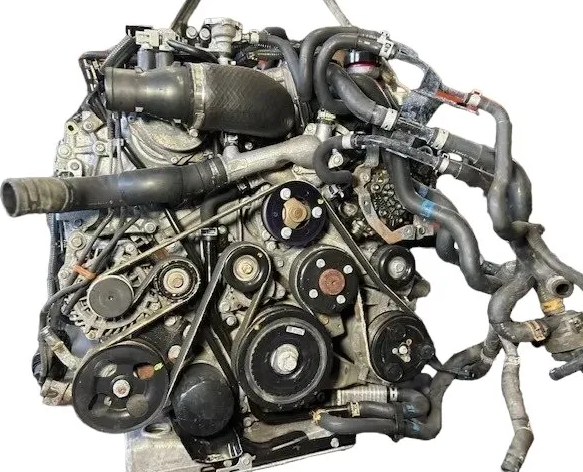
The V9X features a state-of-the-art construction, utilizing a Compacted Graphite Iron (CGI) cylinder block for superior strength and vibration damping, complemented by lightweight aluminum cylinder heads. Fuel delivery is managed by a precise common-rail direct injection (CRDI) system with piezoelectric injectors, ensuring efficient combustion and lower emissions. A key performance enhancer is the Variable Geometry Turbocharger (VGT), providing rapid throttle response across the RPM range. The valvetrain is a double overhead camshaft (DOHC) design, actuating four valves per cylinder, contributing to optimal airflow. Emissions control includes an Exhaust Gas Recirculation (EGR) system and a Diesel Particulate Filter (DPF).
This engine saw deployment in several Infiniti models, including the Infiniti FX30d (S51) from 2010 to 2013, the Infiniti M30d (Y51) (later rebranded as Q70 3.0d) from 2010 to 2014, and the Infiniti EX30d (J50) (later QX50 3.0d) from 2010 to 2014. Beyond Infiniti, the V9X was also utilized in certain Nissan Navara (D40) and Pathfinder (R51) models, and within the Renault lineup for the Laguna III and Latitude, underscoring its versatility across the Alliance’s vehicle portfolio.
Technical Specifications
| Specification | Value |
|---|---|
| Displacement (cc) | 2993 |
| Max Power (hp (kW) @ RPM) | 238 (175) @ 3750 |
| Max Torque (Nm (kg*m) @ RPM) | 550 (56.1) @ 1750-2500 |
| Fuel Type | Diesel |
| Fuel Consumption (l/100 km) | ~9.0 (Combined, representative for FX30d) |
| Engine Type | V6, Turbodiesel, DOHC, Common Rail Direct Injection |
| Compression Ratio | 16.0:1 |
| Cylinder Bore (mm) | 84.0 |
| Piston Stroke (mm) | 90.0 |
| Valvetrain | DOHC, Chain-driven |
| Valves per Cylinder | 4 |
| Additional Info | Variable Geometry Turbocharger (VGT), Piezoelectric Injectors, Diesel Particulate Filter (DPF), Exhaust Gas Recirculation (EGR) |
Common Problems & Reliability
The Infiniti V9X engine, while generally robust, exhibits a few well-documented susceptibility areas that require proactive attention. A primary concern involves the oil cooler and EGR cooler assembly failures. These components are prone to developing leaks, which can lead to coolant loss, cross-contamination with engine oil, or, if left unaddressed, potential internal engine damage. Early detection of coolant level drops or unusual oil characteristics is critical.
Another common issue stems from the intake manifold swirl flaps and their actuating mechanism. Carbon buildup, inherent to direct injection diesel engines and exacerbated by EGR systems, can cause these flaps to stick or the plastic linkages to fail. This leads to reduced engine performance, check engine lights, and can impede proper DPF regeneration cycles. Remedial action often involves cleaning or replacement of the intake manifold assembly.
Like most modern turbodiesel engines, the V9X is susceptible to Diesel Particulate Filter (DPF) clogging, especially in vehicles primarily used for short-distance city driving. Insufficient DPF regeneration cycles lead to increased exhaust backpressure, reduced power, and eventually costly DPF replacement. Proactive maintenance and appropriate driving cycles are essential for DPF longevity.
With proper, diligent maintenance, the Infiniti V9X engine can achieve a realistic service life of 250,000 to 300,000 kilometers (approximately 150,000 to 180,000 miles) before major components like the turbocharger, injectors, or high-pressure fuel pump may require significant attention or overhaul. Many examples exceed this mileage with a history of meticulous care.
Maintenance Tips & Service Schedule
- Engine Oil and Filter Change: Essential every 10,000 to 15,000 kilometers (6,000 to 9,000 miles) or annually, whichever comes first. Use a high-quality synthetic engine oil conforming to ACEA C3 low-SAPS (Sulphated Ash, Phosphorus, Sulphur) specifications, typically 5W-30 or 0W-30, specifically approved for DPF-equipped diesel engines (e.g., meeting Renault RN0720).
- Fuel Filter Replacement: Crucial for protecting the high-pressure common rail system, replacement is recommended every 20,000 to 30,000 kilometers (12,000 to 18,000 miles).
- Air Filter Replacement: To ensure optimal engine breathing, replace the air filter every 30,000 to 45,000 kilometers (18,000 to 28,000 miles), or more frequently in dusty conditions.
- Coolant Flush and Replacement: The engine cooling system benefits from a flush and refill every 5 years or 100,000 kilometers (60,000 miles), using manufacturer-approved long-life coolant.
- DPF Management: Regular driving at highway speeds for extended periods (20-30 minutes) is recommended to facilitate active DPF regeneration cycles. Avoiding excessive short trips helps prevent premature DPF clogging.
- EGR System and Intake Manifold Cleaning: Proactive inspection and cleaning of the EGR valve and intake manifold swirl flap area can significantly mitigate carbon buildup issues and prolong component life.
- Timing Chain Inspection: The V9X utilizes a timing chain designed for the engine’s lifetime. However, at higher mileages (e.g., over 200,000 km), it is prudent to have the chain and tensioners inspected by a qualified technician if any unusual noises are present.
Conclusion
The Infiniti V9X engine presents a compelling option for a used vehicle buyer seeking strong V6 turbodiesel performance and relative efficiency. It offers substantial torque delivery and a refined driving experience. As with any complex modern diesel, its long-term reliability is directly proportional to its maintenance history. Vehicles equipped with the V9X engine can be considered a safe and reliable choice provided there is comprehensive evidence of diligent servicing and proactive attention to its known mechanical weak points, particularly the oil cooler/EGR cooler assembly and intake manifold swirl flaps. A thorough pre-purchase inspection focusing on these specific components and verification of DPF health are highly recommended to ensure a positive ownership experience.