
In 1969, KamAZ trucks were first manufactured. Engineers have developed an 8-cylinder, 4-stroke diesel KamAZ-740 V8 engine for the next generation of trucks. This power unit produced 210 horsepower and had a displacement of 10852 cm3. After that, it was necessary to increase the power ratings from 180 to 360 horsepower. Compared to the same YaMZ-238, the motor is smaller and lighter.
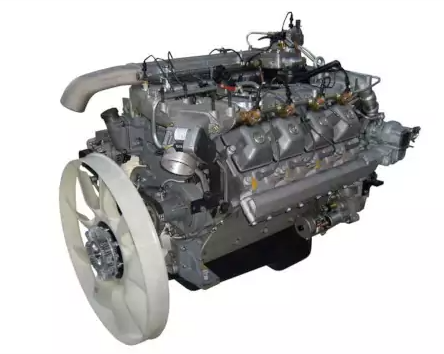
Spur gears are used to transfer torque from the motor to the main units. Thus, the gears are utilized for the hydraulic booster, pumps, compressors, and gas distribution system drives. Even in extremely cold weather, the KamAZ-740 engine starts well. The power of the battery, starter, and heater of the units prior to starting makes this possible.
Specifications
| Engine’s type | diesel turbo |
| Configuration | V-8 |
| Valves | 16 |
| Power output, hp | from 210 for the first modifications to 440 for the last |
| Torque output, Nm | from 667 for the first modifications to 2060 for the last |
| Euro standards | from Euro 0 for the first modifications to Euro 5 for the last |
| Displacement, liters | 10,85 / 11,76 |
| Cylinder bore, mm | 120 |
| Piston stroke, mm | 120/130 |
| Compression ratio | 16.0 / 16.8 / 17.0 |
| Weight, kg | 835 |
| Cylinder block alloy | cast iron |
Crankshafts, pistons, piston rings, piston pins, modified heads, turbochargers without intercoolers, YAZDA 337 pumps, and 273 injectors are characteristics that set motors under Euro-1 apart.
Pistons from Euro-1, an air intercooler, and a crankshaft with a different flywheel mount are used for engines under Euro-2 with a 120 mm stroke. Additionally, there are Euro-2 engines with a displacement of 11.76 liters and a piston stroke of 130 mm. Some pistons are 70.7 mm tall, and their liners and piston pins are still outdated.
Based on Euro-2, Euro-3 diesels have more robust heads, different crankshafts, piston rings, and 274 injectors.
Pistons, piston pins, rings, heads with a common rail injection system, and the presence of an SCR catalyst are what set KamAZ Euro-4 engines apart.
Modifications of KamAZ-740
According to Euro-0 standards, the KamAZ-740.10 is an atmospheric engine that can produce 210 horsepower at 2600 rpm and 667 Nm of torque at 1600–1800 rpm.
The identical model, KamAZ-740.10-20, has 271 injectors.
Based on the 740.10, the KamAZ-7403.10 is a turbo engine with pistons for a compression ratio of 16 (larger combustion chamber), its own piston pins, a different intake system, injection pump 334, 271 injectors, and TKR 7N1K turbines. The camshaft is still outdated. The motor meets Euro-0 requirements. 260 horsepower at 2600 rpm and 834 Nm of torque at 1600–1800 rpm.
The KamAZ-740.11-240 is a Euro-1 turbodiesel with a YAZDA 337-40 high pressure fuel pump, 273-31 injectors, a compression ratio of 16.5, 240 horsepower at 2200 rpm, and 834 Nm of torque at 1400 rpm. There is no intercooler on the motor.
The KamAZ-740.13-260 is an analog of the 740.11-240 with YAZDA 337-42 and 273-20 injectors, increasing power to 260 horsepower.
The model for Euro-2 standards is KamAZ-740.30-260. There are YAZDA 337-20 pumps, 273-20 injectors, and TKR 700 turbines with intercoolers. 260 horsepower at 2200 rpm and 1079 Nm of torque at 1300 rpm.
An analog of the 740.30, the KamAZ-740.31-240 has 240 horsepower instead.
The KamAZ-740.35-400 model has a crankshaft with a 130 mm piston stroke, allowing for an increase in working volume to 11.76 liters and a compression ratio of 16.8. TKR 700 turbines with an intercooler, injection pump 337-24, injectors 274-22, and ELARA 50.3763 ECU are available. At 2200 rpm, power equals 400 horsepower, and at 1400 rpm, torque equals 1570 Nm.
The KamAZ-740.37-400 is identical to the 740.35, but it has a Bosch PE8P120A920/5RV pump, AZPI 216-02 injectors, a Bosch MS6.1 control unit, and 400 horsepower at 1900 rpm and 1766 Nm of torque at 1300 rpm.
An analog of the 740.37, the KamAZ-740.38-360 has a lower output of 360 horsepower at 1900 rpm and 1569 Nm of torque at 1200–1400 rpm.
The Euro-2 KamAZ-740.50-360 has a YAZDA 337-20 pump, 273-20 injectors, TKR-700 turbines, and an intercooler. 360 horsepower at 2200 rpm and 1472 Nm of torque at 1400 rpm.
The same model, KamAZ-740.51-320, has 320 horsepower at 2200 rpm and 1275 Nm of torque at 1400 rpm.
Version KamAZ-740.52-260: 260 horsepower
The KamAZ-740.53-290 model has 290 horsepower.
KamAZ-740.55-300: KamAZ-43118 modified to produce 300 horsepower.
KamAZ-740.60-360: This Euro-3 modification has an electronic injection pump (YAZDA 337-23), injectors (274-20), turbochargers (TKR-700), and an ECU (ELARA 50.3763). The motor started to produce 360 horsepower at 1900 rpm and 1570 Nm of torque at 1300 rpm.
An analog of the engine mentioned above, the KamAZ-740.61-320 produces 320 horsepower for the KamAZ-6520. This pump is a 337-23.01.
The KamAZ-740.62-280 is a 280 horsepower turbodiesel with a 337-23.02 pump.
A 400-strong Euro-3 version for KamAZ-6460, 6520, and 65225 is called KamAZ-740.63-400. Bosch electronics (pump PE8P120A920 / 5RV, ECU MS 6.1) and AZPI 216 injectors are available.
For KamAZ-5460 and LiAZ-5256, the Euro-3 KamAZ-740.64-420 model has 420 horsepower.
KamAZ-740.65-240: ecological class Euro-3 modification with 240 horsepower. A YAZDA 337-23.03/04 pump, 274-40/41 injectors, and an ELARA 50.3763 control unit are present.
The KamAZ-740.602-360 model has common rail injection and is classified as environmental class 4 (rules 96-02). 360 horsepower is produced by the internal combustion engine.
The analog of the 740.602 for 320 horsepower is KamAZ-740.612-320.
KamAZ-740.622-280: 280 horsepower variant
Model KamAZ-740.632-400: 400 horsepower
The top model in this series, the KamAZ-740.642-420, produces 420 horsepower.
Version KamAZ-740.652-260: 260 horsepower
There are 300 in the KamAZ-740.662-300 model.
An analog of 740.602, KamAZ-740.70-280 complies with Euro-4 standards and has a scr catalyst.
KamAZ-740.71-320: the same diesel with 320 horsepower
The KamAZ-740.72-360 is an even more potent model with 360 horsepower.
Version KamAZ-740.73-400: 400 horsepower
420 horsepower analog KamAZ-740.74-420
The most potent model in the Euro-4 line, the KamAZ-740.75-440, has 440 horsepower.
The Euro-5 KamAZ-740.705-300 has 300 horsepower.
The identical model under the fifth ecological class for 360 horsepower is KamAZ-740.725-360.
Version KamAZ-740.735-400: 400 horsepower
The gas-diesel KamAZ-7409 engine powers the KamAZ-5320.
Frequent problems
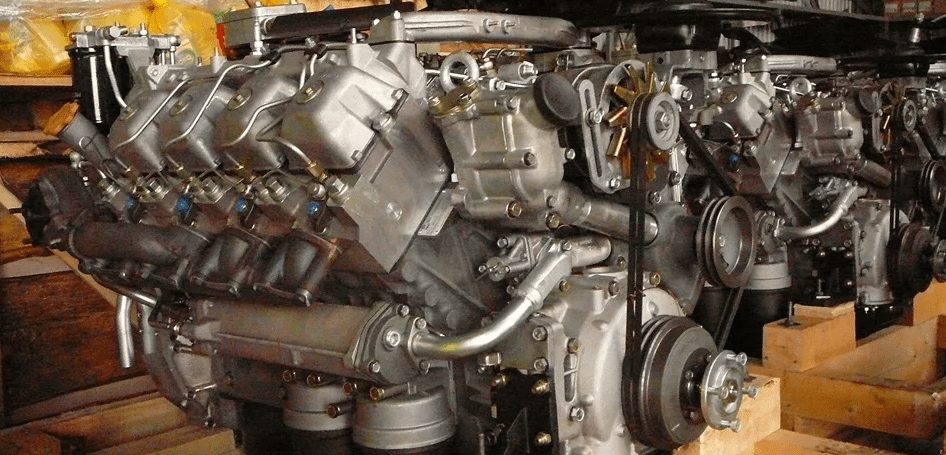
The primary issues with the KamAZ 740 engines, according to the car’s owners, are abrupt power drops and increases, as well as increased fuel and lubricant consumption. The high exhaust smoke level is another common issue. It is not unusual for the lubrication system to experience pressure drop. The device may idle unsteadily, and various unnecessary noises may occasionally be heard in various nodes. The crankshaft is responsible for the majority of the problems. A coolant leak could occur.
Repairs are unavoidable if the engine has been overused and, more frequently, if it has not been properly maintained. However, the car will be able to function at full strength and possibly even better after a significant overhaul.
On the left-hand block of the course, in front of the engine, is the Kamaz-740 engine number. The number is stamped in the area of the fourth cylinder for engines manufactured prior to 2007.