
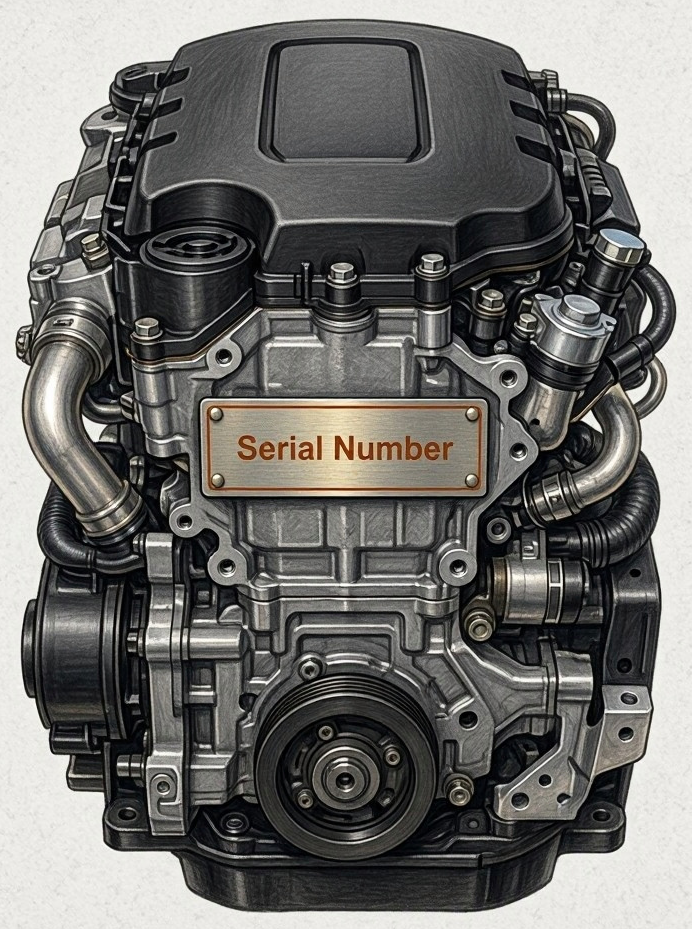
Accurately identifying a Chevrolet engine’s specific code and serial number is paramount for any automotive professional, parts specialist, or enthusiast. This precise identification is critical for ordering correct Original Equipment Manufacturer (OEM) parts, as small variations in engine codes can indicate different cylinder head designs, piston types, camshaft profiles, or sensor requirements. Beyond parts procurement, these unique identifiers are vital for verifying a vehicle’s original powertrain configuration, tracing its service history, checking the applicability of recalls or technical service bulletins (TSBs), and performing due diligence when inspecting a used vehicle or a replacement engine. A meticulous understanding of Chevrolet’s engine identification system safeguards against costly errors and ensures optimal performance and compliance.
Where to Find the Engine Serial Number and Code on Chevrolet Engines
| Engine Series / Layout | Physical Stamp Location | Secondary Sticker / Plate |
|---|---|---|
| Small Block Gen I/II (e.g., 305, 350 SBC, LT1) | Stamped on a machined pad located on the front right (passenger) cylinder head deck, directly below the cylinder head. May also be stamped on the block casting near the oil filter or front timing cover area. | Emissions label on valve cover or radiator support. Metal tag on timing cover bolt. |
| Big Block (e.g., 396, 454, 8.1L) | Stamped on a machined pad on the front right (passenger) cylinder head deck, below the cylinder head. 8.1L engines may have additional stamps near the oil filter or rear block flange. | Emissions label on valve cover. Often a metal tag under a timing cover bolt on earlier models. |
| LS/LT V8 (e.g., LS1, LS2, LS3, LS7, LM7, LQ4, L83, L86, LT1, LT4) | Laser-etched or dot-peen stamped on the rear driver-side block flange near the bellhousing and often on the lower block skirt, close to the oil pan rail on the passenger side. Casting numbers are abundant. | Barcode label on the valve cover, front timing cover, or a specific engine identification sticker on the intake manifold or wiring harness. |
| Ecotec I4 (e.g., L61, LE5, LNF, LTG, L3B) | Stamped or laser-etched on a machined pad typically on the exhaust side of the cylinder block, near the bellhousing flange or below the cylinder head. | Barcode label on the valve cover, intake manifold, or timing chain cover. Emissions sticker on radiator support. |
| High Feature V6 (e.g., LFX, LGX) | Stamped or laser-etched on the rear face of the engine block, near the transmission bellhousing mating surface, usually on the driver’s side. Sometimes on a machined pad below the cylinder head. | Barcode label on the valve cover or intake manifold. Emissions label on the radiator support. |
| Duramax Diesel (e.g., LB7, LLY, LBZ, LMM, LML, L5P) | Laser-etched or dot-peen stamped on the rear driver-side block flange near the bellhousing, often visible from below or the driver’s side wheel well. May also be on a pad on the front of the block. | Engine identification sticker on the valve cover, front timing cover, or emission label on the radiator support. |
To physically locate and decipher Chevrolet engine identification numbers, a methodical approach is essential. For classic Small Block and Big Block engines (Gen I/II, 396, 454), the primary stamping pad is usually found on the front right (passenger) cylinder head deck. This small, flat, machined area is positioned just below the passenger-side cylinder head, often obscured by accessories, exhaust manifolds, or accumulated grime. Access typically requires clearing these obstructions and thoroughly cleaning the pad with a wire brush and solvent, being careful not to abrade the metal and obliterate the shallow stamping. On these older engines, the numbers are often deeply stamped characters.
For more modern engines, including LS/LT V8s, Duramax Diesels, Ecotec I4s, and High Feature V6s, the location of the serial number and engine code has shifted significantly. These engines typically feature laser-etched or dot-peen stamped markings on the rear driver-side block flange, adjacent to where the engine mates with the transmission bellhousing. This placement often requires accessing the engine from underneath the vehicle, or from the transmission tunnel after removing interior components. On some LS/LT engines, secondary identification may be found on the lower block skirt near the oil pan rail on the passenger side. Due to the precision of laser etching or dot-peen stamping, these markings can be quite shallow and prone to obscuration by road grime, paint, or surface corrosion. A very bright flashlight, a magnifying glass, and a gentle cleaning with a non-abrasive degreaser and soft brush are recommended. Avoid aggressive wire brushing, which can easily erase these delicate markings. Always cross-reference any stamped numbers with secondary labels (barcode stickers on valve covers, timing covers, or intake manifolds) and the Vehicle Identification Number (VIN) to ensure accurate identification.
How to Decode Chevrolet Engine Codes and Serial Numbers
Chevrolet engine codes and serial numbers follow a structured, albeit sometimes complex, logic designed to provide comprehensive information about the engine’s specifications, manufacturing details, and production lineage. While specific formats can vary by generation and engine family, a general pattern typically applies.
- Engine Family & Generation Prefix: These initial alphanumeric characters often denote the overarching engine architecture, such as “LS,” “LT,” “L” (for truck engines), or specific internal designations. They can also indicate block material (e.g., aluminum vs. cast iron), cylinder count, or fundamental design series like “Ecotec.”
- Displacement & Cylinder Configuration: Subsequent characters or digits will often specify the engine’s displacement in liters or cubic inches, and implicitly or explicitly confirm the cylinder count and configuration (e.g., V8, I4, V6). For example, “3” in an LS3 denotes 6.2L (approximately 376 cubic inches).
- Fuel System, Aspiration & Valvetrain: Characters here can differentiate between gasoline and diesel applications, indicate forced induction (turbocharging or supercharging), or specify advanced valvetrain technologies such as Direct Injection (DI), Variable Valve Timing (VVT), or Active Fuel Management (AFM)/Dynamic Fuel Management (DFM).
- Power Output, Revision & Emissions Spec: Trailing letters or digits frequently denote specific horsepower tuning tiers, minor technical revisions or updates within an engine generation, or adherence to particular regional emissions standards (e.g., California emissions vs. Federal).
- Sequential Serial Number String: This unique sequence of digits and letters provides the engine’s individual identity. It typically includes a single-digit year identifier (often the last digit of the calendar year, e.g., ‘1’ for 2011 or 2021), a manufacturing plant code (one or two letters), and a sequential production number for that plant and year.
Real-World Chevrolet Engine Code Examples
Understanding the character-by-character breakdown of actual Chevrolet engine codes and serial numbers provides practical insight into their decoding methodology. Note that specific interpretations for plant codes and date formats can vary slightly by engine generation and production era.
- LS3 10H184920:
- LS3: Identifies the engine as an LS Generation IV Small Block V8, 6.2L (376 cubic inches), aluminum block, typically producing 430-436 horsepower, featuring advanced cylinder head design and often found in performance applications like the Chevrolet Corvette, Camaro SS, and Pontiac G8 GXP.
- 1: Represents the model year digit, typically the last digit of the production year. In this context, it could signify 2011.
- 0H: This is generally a plant code and/or partial date code. “0” might indicate a month (e.g., October or a different sequential digit), and “H” could be a specific manufacturing plant or a day of the month/week. Precise interpretation often requires a factory service manual or specialized database lookup.
- 184920: This is the unique sequential production number assigned to this specific engine unit at the manufacturing plant during its production year.
- L83 16B094812:
- L83: Designates this as a Generation V Small Block V8, 5.3L (325 cubic inches), aluminum block with direct injection (DI), Active Fuel Management (AFM), and Variable Valve Timing (VVT). Commonly found in Chevrolet Silverado, Tahoe, Suburban, and GMC Sierra, Yukon models from 2014 onwards.
- 1: Represents the model year digit, likely 2011 or 2021. For an L83, 2021 is more probable given its introduction timeline.
- 6B: “6” often signifies the sixth month of the year (June). “B” is typically a plant code for a specific General Motors powertrain facility.
- 094812: This is the unique sequential production number for this specific L83 engine, indicating its order within the manufacturing sequence at its plant during that production period.
- L5P 19D482910:
- L5P: Identifies this as a Duramax 6.6L Turbo-Diesel V8 engine, known for its high power (e.g., 445 hp and 910 lb-ft torque) and advanced emissions controls (SCR, DPF). Introduced in 2017 for heavy-duty applications like the Chevrolet Silverado HD and GMC Sierra HD.
- 1: Represents the model year digit, likely 2021 given the engine’s production window.
- 9D: “9” could denote the ninth month (September). “D” is often a plant code for a specific GM heavy-duty engine or transmission plant.
- 482910: This is the unique sequential production number for this specific L5P Duramax engine, detailing its position in the manufacturing queue at its designated plant for that year.
- LM7 05K194028:
- LM7: Identifies this as a Generation III Small Block V8, 5.3L (325 cubic inches), cast iron block, featuring multi-port fuel injection (MPFI). This engine was a workhorse in Chevrolet Silverado, Tahoe, Suburban, and GMC Sierra, Yukon models from 1999-2007.
- 0: Represents the model year digit, likely 2000.
- 5K: “5” could represent the fifth month (May). “K” often signifies a specific manufacturing plant (e.g., St. Catharines, Ontario, Canada for GM powertrain components).
- 194028: This is the unique sequential production number for this specific LM7 engine, distinguishing it from all other LM7s produced at that facility during that production year.
How to Identify Production Year and Manufacturing Plant
Determining the exact manufacturing year, month/Julian day, assembly plant, and engineering revision from Chevrolet serial digits requires careful cross-referencing and attention to detail. The single-digit year identifier in the engine serial number typically correlates to the last digit of the calendar year (e.g., ‘5’ could be 1995, 2005, or 2015). To confirm the decade, this engine code must be cross-referenced with the vehicle’s VIN (Vehicle Identification Number) or the engine’s casting date clock. The 10th digit of the VIN explicitly denotes the vehicle’s model year, which almost always corresponds to the engine’s production year. Many engine blocks and major components also feature a casting date clock, a circular or semi-circular raised impression with a pointer indicating the month and sometimes the day, along with the year or year digit, providing a precise manufacturing date for the raw casting. Manufacturing plant codes are typically one or two alphanumeric characters embedded within the serial number; these codes correspond to specific General Motors powertrain assembly facilities globally. While a comprehensive list of all plant codes is extensive and proprietary, common codes (e.g., “F” for Flint Engine South, “Y” for Romulus Engine Plant) can often be found in factory service manuals or specialized decoding guides. Engineering revisions might not be explicitly stated in the serial but can be inferred from the overall engine code (e.g., “LS3” vs. “LS3A”) or by specific part numbers on components, which often carry revision letters.
Common Mistakes When Checking Chevrolet Engine Numbers
- Confusing Casting Numbers with the Serial Number: A frequent error is misidentifying raised, sand-cast, or die-cast foundry part numbers (e.g., “12573480” on an LS block) as the engine’s unique serial number. Casting numbers identify the specific component (block, head, intake manifold) and its design revision, but they are common to thousands of units. The true engine serial number is always a flat, machined, stamped, or laser-etched sequence of characters on a specific identification pad.
- Corrosion, Paint, and Road Grime Obscuration: The most common challenge is simply finding and reading the numbers. Decades of engine grime, oil leaks, rust, and multiple layers of paint can completely obscure the shallow laser-etched or dot-peen markings on newer engines, or even deeply stamped characters on older blocks. Aggressive cleaning methods, such as grinding with rotary tools or harsh abrasives, can permanently damage or remove these legal identification marks. Gentle application of degreasers, careful scraping with plastic tools, and thorough wiping are recommended.
- Short-Block or Remanufactured Engine Swaps: When an engine has been replaced with a factory service short-block, a remanufactured unit, or a “crate engine,” the original engine’s serial number will no longer be present or will be replaced by a new sequence corresponding to the replacement unit. Factory service blocks are sometimes supplied without a serial number or with a generic code, which can complicate VIN-to-engine matching. Always check for a replacement engine tag or documentation when a service replacement is suspected.
- Misreading Similar Alphanumeric Characters: The stamping or etching quality can vary, and common character confusions exist. For instance, ‘0’ (zero) can be mistaken for ‘O’ (letter O), ‘1’ (one) for ‘I’ (letter I), ‘5’ for ‘S’, or ‘8’ for ‘B’. Carefully cross-referencing with other known identification details or photographs of typical stamping fonts can help prevent these transcription errors.