
Only from 2000 to 2005 did the company produce the 2.7-liter bi-turbo V6 Audi ARE engine, which was fitted to the C5 body of the Audi A6 and its well-liked Allroad Quattro variant. A revised version of this unit is available under its own BES index.
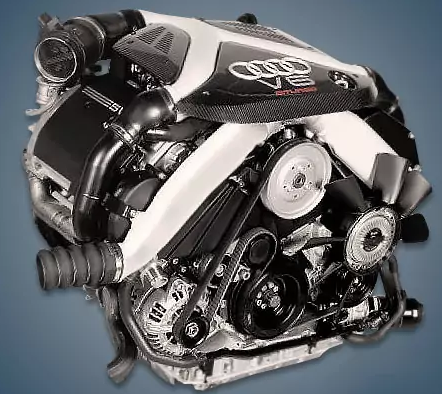
The EA835 series includes: ABC, AAH, ALF, BDV, ARE, ACK, ALG, BBJ, ASN.
Specifications
| Production years | 2000-2005 |
| Displacement, cc | 2671 |
| Fuel system | distributed injection |
| Power output, hp | 250 |
| Torque output, Nm | 350 |
| Cylinder block | aluminum V6 |
| Block head | aluminum 30v |
| Cylinder bore, mm | 81 |
| Piston stroke, mm | 86.4 |
| Compression ratio | 9.3 |
| Features | DOHC |
| Hydraulic lifters | yes |
| Timing drive | 2 chains & belt |
| Phase regulator | yes |
| Turbocharging | 2 BorgWarner K03 |
| Recommended engine oil | 5W-40 |
| Engine oil capacity, liter | 6.5 |
| Fuel type | petrol |
| Euro standards | EURO 3 |
| Fuel consumption, L/100 km (for Audi A6 Allroad 2001) — city — highway — combined |
17.6 9.5 12.6 |
| Engine lifespan, km | ~200 000 |
| Weight, kg | 210 |
The engine was installed on:
- Audi A6 C5 (4B) in 2000 – 2005;
- Audi A6 C5 Allroad (4BH) in 2000 – 2005.
Disadvantages of the Audi ARE engine
First of all, pay attention to cooling because this motor is highly heat-loaded;
Unfortunately, this unit lacks a dependable thermostat and water pump;
Searching for air and oil leaks is a major hassle for the owner; turbines have a limited resource, typically operating less than 100,000 kilometers;
Since the valves bend when the timing belt breaks, it is best to replace it every 60,000 kilometers.
Remember to replace the chains every two belt changes; their jumping poses a risk.
The engine’s heat exchanger, viscous coupling, and ignition coils are additional weak points.
Hello
i am interessted in buying the 2.7-liter bi-turbo V6 Audi ARE engine, please contact me for further information
best regards
Habeeb Karayanni