
Since 2016, the company’s factories have been assembling the 3.0-liter Audi CWGD 3.0 TFSI turbo engine, which is installed on charged versions of well-known models like the A4 B9, A5 F5, or Q5 FY. With 354 horsepower and 500 Nm, this power unit is the most potent in its lineup.
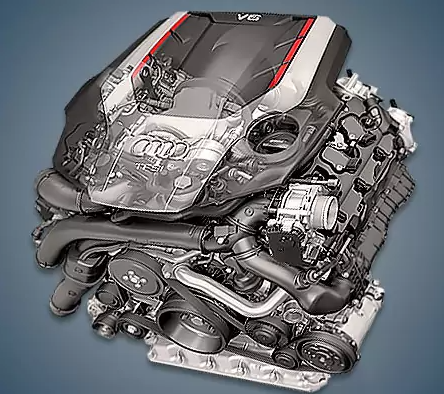
The EA839 series includes: CZSE, DLZA, CWGD, DECA.
Specifications
| Production years | since 2016 |
| Displacement, cc | 2995 |
| Fuel system | direct injection |
| Power output, hp | 354 |
| Torque output, Nm | 500 |
| Cylinder block | aluminum V6 |
| Block head | aluminum 24v |
| Cylinder bore, mm | 84.5 |
| Piston stroke, mm | 89 |
| Compression ratio | 11.2 |
| Features | AVS |
| Hydraulic lifters | yes |
| Timing drive | chain |
| Phase regulator | on all shafts |
| Turbocharging | TwinScroll |
| Recommended engine oil | 0W-20 |
| Engine oil capacity, liter | 7.0 |
| Fuel type | petrol |
| Euro standards | EURO 6 |
| Fuel consumption, L/100 km (for Audi SQ5 2018) — city — highway — combined |
11.4 6.9 8.5 |
| Engine lifespan, km | ~250 000 |
The engine was installed on:
- Audi S4 B9 (8W) since 2016;
- Audi S5 2 (F5) since 2016;
- Audi SQ5 2 (FY) since 2017.
Disadvantages of the Audi CWGD engine
Here, we discuss potential issues with this engine that do not currently exist.
First, costly maintenance: fuel and oil (VW50400, SAE 0W-20).
Second, the turbine in the block collapse is installed in accordance with the plan, with the hot side inside.
Thirdly, the intake manifold cannot be changed separately because it is integrated into the cylinder head.