
Since 2017, the German company has been assembling the 2.9-liter Audi DECA bi-turbo engine, which is limited to the current generation of charged models like the RS4 or RS5. Similar turbo engines are found in Porsche vehicles as MDC.AB and the Audi S6 and S7 as DKMB.
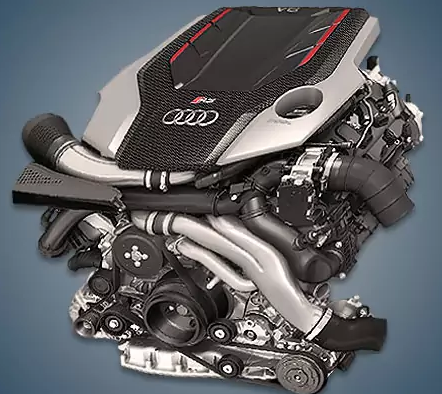
The EA839 series includes: CZSE, DLZA, CWGD, DECA.
Specifications
| Production years | since 2017 |
| Displacement, cc | 2894 |
| Fuel system | direct injection |
| Power output, hp | 450 |
| Torque output, Nm | 600 |
| Cylinder block | aluminum V6 |
| Block head | aluminum 24v |
| Cylinder bore, mm | 84.5 |
| Piston stroke, mm | 86 |
| Compression ratio | 10.0 |
| Features | intercooler |
| Hydraulic lifters | yes |
| Timing drive | chain |
| Phase regulator | yes |
| Turbocharging | Twin-Turbo |
| Recommended engine oil | 0W-20 |
| Engine oil capacity, liter | 7.6 |
| Fuel type | petrol |
| Euro standards | EURO 6 |
| Fuel consumption, L/100 km (for Audi RS5 2020) — city — highway — combined |
11.8 6.9 8.7 |
| Engine lifespan, km | ~200 000 |
The engine was installed on:
- Audi RS4 B9 (8W) since 2017;
- Audi RS5 2 (F5) since 2017.
Disadvantages of the Audi DECA engine
Although the owners’ cooling system isn’t the most effective,
Although there are complaints about electrical issues, flashing usually resolves them;
Although there is no information on bullying, it is recommended on specialized forums to only use high-octane gasoline. Additionally, keep an eye on the radiators’ cleanliness because dirt quickly overgrows them.