
From 2008 to 2013, the American versions of several well-known models, including the A4, A5, A6, and Q5, were equipped with the Audi CAEB or A4 2.0 TFSI 2.0-liter turbo engine. The motor functioned as an analog of the European CDNC unit and was modified to meet ULEV 2 environmental standards.
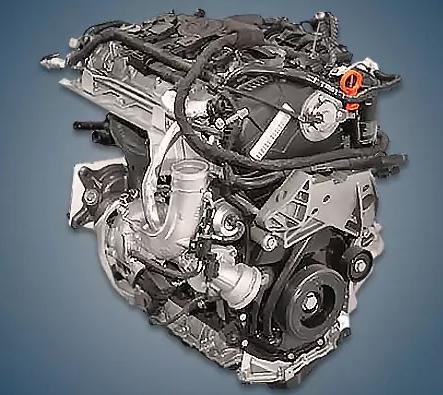
The EA888 gen2 series includes: CDAA, CDAB, CDHA, CDHB, CCZA, CCZB, CCZC, CCZD, CDNB, CDNC, CAEA, CAEB.
Specifications
| Production years | 2008-2013 |
| Displacement, cc | 1984 |
| Fuel system | direct injection |
| Power output, hp | 211 |
| Torque output, Nm | 350 |
| Cylinder block | cast iron R4 |
| Block head | aluminum 16v |
| Cylinder bore, mm | 82.5 |
| Piston stroke, mm | 92.8 |
| Compression ratio | 9.6 |
| Features | DOHC, AVS |
| Hydraulic lifters | yes |
| Timing drive | chain |
| Phase regulator | on the intake shaft |
| Turbocharging | KKK K03 |
| Recommended engine oil | 5W-30 |
| Engine oil capacity, liter | 4.6 |
| Fuel type | petrol |
| Euro standards | ULEV 2 |
| Fuel consumption, L/100 km (for Audi A4 2011) — city — highway — combined |
9.4 5.7 7.1 |
| Engine lifespan, km | ~240 000 |
| Weight, kg | 142 |
The engine was installed on:
- Audi A4 B8 (8K) in 2008 – 2013;
- Audi A5 1 (8T) in 2008 – 2013;
- Audi A6 C7 (4G) in 2011 – 2013;
- Audi Q5 1 (8R) in 2008 – 2012.
Disadvantages of the Audi CAEB engine
The engine’s notoriously high oil consumption is caused by an unsuccessful piston group; the only way to eliminate the oil burner is to replace the pistons, such as forged ones;
Rapid coking and unstable engine operation are caused by persistent oil burnout; the timing chain has a limited resource and occasionally travels less than 100,000 kilometers;
The engine’s water pump, injection pump, and ignition coils are also weak points.