
From 2008 to 2014, the company assembled the 2.0-liter turbocharged Audi CAEA or A5 2.0 TFSI and performed American modifications on popular models like the A4, A5, and Q5 crossover. The motor’s European version, known as CDNB under Euro 5, complied with ULEV 2 environmental standards.
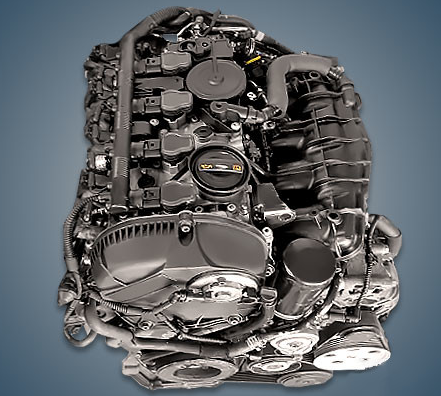
The EA888 gen2 series includes: CDAA, CDAB, CDHA, CDHB, CCZA, CCZB, CCZC, CCZD, CDNB, CDNC, CAEA, CAEB.
Specifications
| Production years | 2008-2014 |
| Displacement, cc | 1984 |
| Fuel system | direct injection |
| Power output, hp | 180 |
| Torque output, Nm | 320 |
| Cylinder block | cast iron R4 |
| Block head | aluminum 16v |
| Cylinder bore, mm | 82.5 |
| Piston stroke, mm | 92.8 |
| Compression ratio | 9.6 |
| Features | DOHC, AVS |
| Hydraulic lifters | yes |
| Timing drive | chain |
| Phase regulator | on the intake shaft |
| Turbocharging | KKK K03 |
| Recommended engine oil | 5W-30 |
| Engine oil capacity, liter | 4.6 |
| Fuel type | petrol |
| Euro standards | ULEV 2 |
| Fuel consumption, L/100 km (for Audi A5 2011) — city — highway — combined |
8.4 5.4 6.5 |
| Engine lifespan, km | ~250 000 |
| Weight, kg | 142 |
The engine was installed on:
- Audi A4 B8 (8K) in 2008 – 2011;
- Audi A5 1 (8T) in 2008 – 2011;
- Audi Q5 1 (8R) in 2009 – 2014.
Disadvantages of the Audi CAEA engine
Due to a faulty piston group, this unit is notorious for using a lot of oil;
For example, you can use forged pistons to save the engine from the oil burner;
Additionally, oil waste causes floating revolutions and the quick formation of carbon deposits;
Here, the timing chain has a small resource that can occasionally reach 100,000 kilometers;
The engine’s water pump, ignition coils, and injection pump are additional weak points.