
From 2000 to 2005, the company assembled the 1.8-liter Audi APG 20v gasoline engine, which was fitted to some Seat models and the redesigned first-generation A3. In actuality, this power unit was an ecologically modified version of the AGN engine.
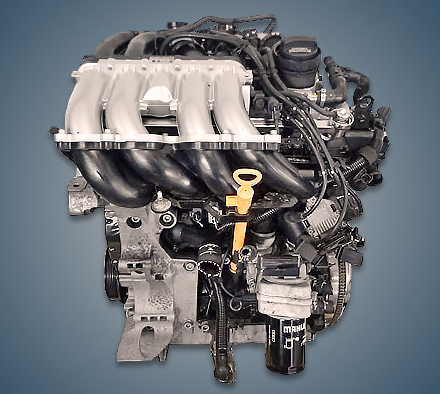
The EA113-1.8 series includes: AGN, APG.
Specifications
| Production years | 2000-2005 |
| Displacement, cc | 1781 |
| Fuel system | injector |
| Power output, hp | 125 |
| Torque output, Nm | 170 |
| Cylinder block | cast iron R4 |
| Block head | aluminum 20v |
| Cylinder bore, mm | 81 |
| Piston stroke, mm | 86.4 |
| Compression ratio | 10.3 |
| Features | DOHC |
| Hydraulic lifters | yes |
| Timing drive | chain & belt |
| Phase regulator | no |
| Turbocharging | no |
| Recommended engine oil | 5W-30 |
| Engine oil capacity, liter | 4.5 |
| Fuel type | petrol |
| Euro standards | EURO 3 |
| Fuel consumption, L/100 km (for Audi A3 2002) — city — highway — combined |
10.6 6.2 7.8 |
| Engine lifespan, km | ~350 000 |
The engine was installed on:
- Audi A3 1 (8L) in 2000 – 2003;
- Seat Leon 1 (1M) in 2000 – 2005;
- Seat Toledo 2 (1M) in 2000 – 2004.
Disadvantages of the Audi APG engine
Owners rarely worry about a straightforward and dependable power unit.
The throttle or injector contamination is the cause of the floating engine speed.
Additionally, the intake manifold’s vacuum regulator flaps occasionally stick.
Lambda probes, a mass air flow sensor, and a coolant temperature sensor are the most common electrical failures in this situation.
Numerous issues can arise from an erratic crankcase ventilation system.