
From 2008 to 2013, the German company assembled the 2.0-liter Audi CDNC 2.0 TFSI engine, which was fitted to the company’s best-selling models, the A4, A5, and Q5. The unit’s power increased to 225 horsepower following the modernization, and it was given a new CNCD index.
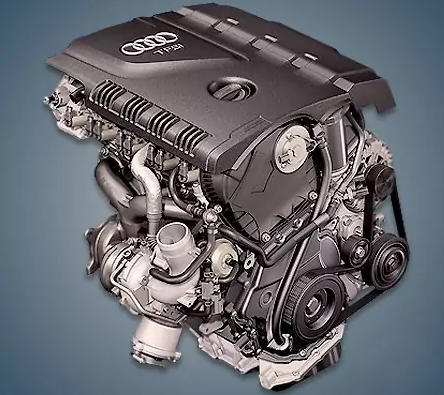
The EA888 gen2 series includes: CDAA, CDAB, CDHA, CDHB, CCZA, CCZB, CCZC, CCZD, CDNB, CDNC, CAEA, CAEB.
The EA888 gen2 turbo engines, specifically the 2.0-liter CDNC unit, made their debut in 2008. An aluminum 16-valve cylinder head with hydraulic lifters, a three-chain timing drive, a dephaser on the intake shaft, an in-line 4-cylinder cast-iron block with a closed cooling jacket, direct fuel injection, and an IHI RHF5 turbine with an intercooler are all included in the design. A variable displacement oil pump, an intake manifold with geometry change dampers, two balancers with independent drives, and an Audi Valvelift System (AVS) that modifies the height of the lift of the exhaust valves are among the features of this motor.
Specifications
| Production years | 2008-2013 |
| Displacement, cc | 1984 |
| Fuel system | direct injection |
| Power output, hp | 211 |
| Torque output, Nm | 350 |
| Cylinder block | cast iron R4 |
| Block head | aluminum 16v |
| Cylinder bore, mm | 82.5 |
| Piston stroke, mm | 92.8 |
| Compression ratio | 9.6 |
| Features | AVS |
| Hydraulic lifters | yes |
| Timing drive | chains |
| Phase regulator | on the intake shaft |
| Turbocharging | IHI RHF5 |
| Recommended engine oil | 0W-30, 5W-40 (approved VW 502.00 or 505.00) |
| Engine oil capacity, liter | 4.6 |
| Fuel type | petrol |
| Euro standards | EURO 5 |
| Fuel consumption, L/100 km (for Audi Q5 2009) — city — highway — combined |
10.0 6.9 7.4 |
| Engine lifespan, km | ~300 000 |
| Weight, kg | 142 |
The engine was installed on:
- Audi A4 B8 (8K) in 2008 – 2013;
- Audi A5 1 (8T) in 2008 – 2013;
- Audi Q5 1 (8R) in 2008 – 2012.
Disadvantages of the Audi CDNC engine
The most well-known issue with the second generation EA888 turbo engines is oil burn caused by thin-ringed pistons and tiny grease-draining holes. Although the VW company has released a number of repair piston revisions, purchasing forged ones is preferable.
The coking of intake valves caused by the direct injection system is the reason why owners of vehicles with such engines frequently experience floating engine speeds. Contamination and a wedge of the intake manifold swirl flaps are additional culprits.
Up until 2012, if you left the car in gear on a slope, the timing chain could already stretch to 50,000 kilometers or jump because of a weak tensioner. After the engine was updated, everything started to function flawlessly for 100–150 thousand kilometers.
The oil filter in this power unit is situated on top for simple replacement. Additionally, the bracket has a tube with a pressure-reducing valve to stop oil from draining. It stops working when its sealing rings deteriorate.
The motor requires a lot of maintenance, particularly with regard to lubricant quality. The phase regulator fails when impurities clog the oil channel filters, and the balancer shaft filters jam and break the circuit.
This unit makes use of a contemporary variable displacement oil pump that operates in two modes: it generates 1.8 bar of pressure up to 3500 rpm and 3.3 bar after that. The design proved to be unreliable, and when it malfunctions, the results are frequently lethal.
The booster pump control unit, short-lived supports, a pump that leaks through the case, a weak vacuum pump gasket, and frequently torn membranes of the oil separator and turbocharger bypass valve are additional engine weaknesses. The ignition coils don’t last long if you replace the candles in accordance with the regulations every 90,000 kilometers.