
Since 2018, the German company’s plant has assembled the 3.0-liter Audi DLZA 3.0 TFSI engine, which is fitted to the company’s largest mid-size models, the A6 and A7 in the C8 body. This unit has its own 48-volt network and is part of a hybrid installation.
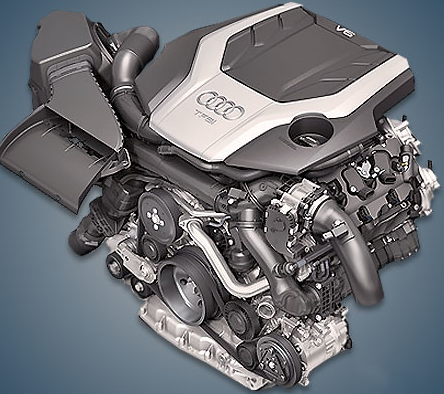
The EA839 series includes: CZSE, DLZA, CWGD, DECA.
Specifications
| Production years | since 2018 |
| Displacement, cc | 2995 |
| Fuel system | direct injection |
| Power output, hp | 340 |
| Torque output, Nm | 500 |
| Cylinder block | aluminum V6 |
| Block head | aluminum 24v |
| Cylinder bore, mm | 84.5 |
| Piston stroke, mm | 89 |
| Compression ratio | 11.2 |
| Features | mild hybrid |
| Hydraulic lifters | yes |
| Timing drive | chain |
| Phase regulator | on all shafts |
| Turbocharging | TwinScroll |
| Recommended engine oil | 0W-20 |
| Engine oil capacity, liter | 7.0 |
| Fuel type | petrol |
| Euro standards | EURO 6 |
| Fuel consumption, L/100 km (for Audi A7 2019) — city — highway — combined |
9.2 5.6 6.9 |
| Engine lifespan, km | ~270 000 |
The engine was installed on:
- Audi A6 C8 (4K) since 2018;
- Audi A7 C8 (4K) since 2018.
Disadvantages of the Audi DLZA engine
There are no breakdown statistics for this turbo engine because it has only recently started to be installed.
The cylinder head and intake manifold are now integrated and cannot be swapped out separately.
The hot side of the turbocharger is facing inward as the cylinder block collapses.