
Since 2018, the company has been producing the 2.5-liter 5-cylinder turbo-engine Audi DNWA, which powers vehicles like the RS Q3 crossover, TT RS coupe, and RS3 hatchback. The DNWC unit, which has a 400 horsepower and 500 Nm capacity, is a feature of the contemporary Audi RS3.
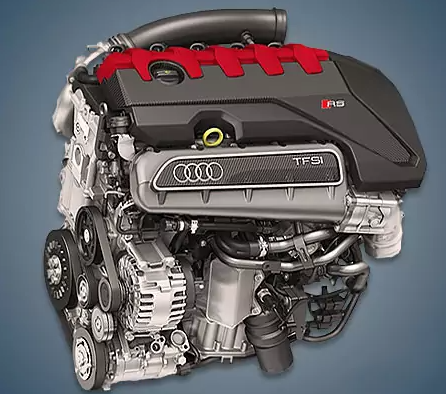
The EA855 series includes: BGP, CBTA, CEPA, CTSA, DAZA, DNWA.
Specifications
| Production years | since 2018 |
| Displacement, cc | 2480 |
| Fuel system | MPI + FSI |
| Power output, hp | 400 |
| Torque output, Nm | 480 |
| Cylinder block | aluminum R5 |
| Block head | aluminum 20v |
| Cylinder bore, mm | 82.5 |
| Piston stroke, mm | 92.8 |
| Compression ratio | 10.0 |
| Features | AVS |
| Hydraulic lifters | no |
| Timing drive | chain |
| Phase regulator | on both shafts |
| Turbocharging | BorgWarner B03G |
| Recommended engine oil | 0W-30 |
| Engine oil capacity, liter | 7.1 |
| Fuel type | petrol |
| Euro standards | EURO 6d-TEMP |
| Fuel consumption, L/100 km (for Audi TT RS 2021) — city — highway — combined |
11.4 6.6 8.2 |
| Engine lifespan, km | ~250 000 |
| Weight, kg | 160 |
The engine was installed on:
- Audi RS3 3 (8V) in 2018 – 2020;
- Audi RS Q3 2 (F3) since 2019;
- Audi TT RS 3 (8S) in 2020 – 2023.
Disadvantages of the Audi DNWA engine
The owners’ unchecked desire for tuning is the primary issue with such units.
However, there aren’t many issues with this turbo engine when it’s in stock.
Additionally, using an aluminum block with plasma spraying in place of sleeves is trouble-free.
Only a few complaints regarding vacuum tube cracks were found on specialized forums.