
From 1989 to 1994, the company manufactured a 2.5-liter Land Rover 200Tdi diesel engine, which was fitted to the Defender SUV under the 11L index and the Discovery under the 12L and 13L index. The 300Tdi engine swiftly replaced this power unit, which had a mechanical injection pump.
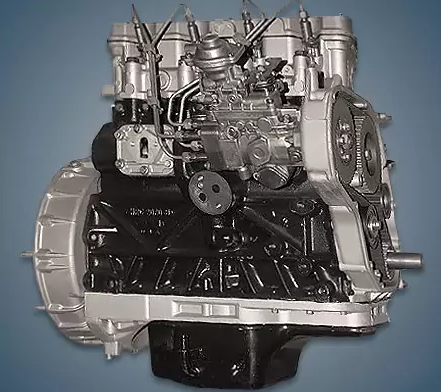
Specifications
| Production years | 1989-1994 |
| Displacement, cc | 2495 |
| Fuel system | direct injection |
| Power output, hp | 107 – 111 |
| Torque output, Nm | 265 |
| Cylinder block | cast iron R4 |
| Block head | aluminum 8v |
| Cylinder bore, mm | 90.47 |
| Piston stroke, mm | 97 |
| Compression ratio | 19.5 |
| Features | OHV |
| Hydraulic lifters | no |
| Timing drive | belt |
| Phase regulator | no |
| Turbocharging | Garrett TB02 |
| Recommended engine oil | 5W-40 |
| Engine oil capacity, liter | 6.7 |
| Fuel type | diesel |
| Euro standards | EURO 1 |
| Fuel consumption, L/100 km (for Land Rover Defender 1992) — city — highway — combined |
12.7 8.7 10.8 |
| Engine lifespan, km | ~350 000 |
The engine was installed on:
- Land Rover Defender 1 (L316) in 1990 – 1994;
- Land Rover Discovery 1 (LJ) in 1989 – 1994;
- Land Rover Range Rover 1 (LH) in 1992 – 1994.
Disadvantages of the Land Rover 200Tdi engine
This diesel engine, which has a Bosch mechanical injection pump, is dependable and has a very straightforward design.
Its primary issue is that it was only made for a brief period of time and that replacement parts are pricey.
They complain about a vacuum pump, antifreeze leaks, and cylinder head gasket failure on specialized forums.
The timing belt must be replaced and the valve clearances adjusted every 80,000 kilometers.
You shouldn’t turn off the car right away after a trip so that the turbine can continue to function for a long time.