
From 2006 to 2010, the company produced the 3.6-liter Land Rover 368DT or Range Rover Sport 3.6 TDV8 engine, which was fitted to its biggest and most costly SUVs. Later, a 4.4-liter diesel engine with even greater power was developed based on this power unit.
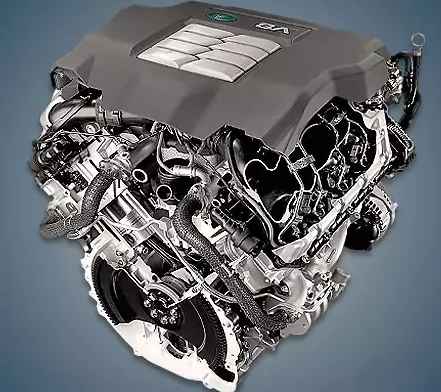
224DT, 276DT, 306DT, 368DT, and 448DT are jointly developed engines with Ford.
Specifications
| Production years | 2006-2010 |
| Displacement, cc | 3628 |
| Fuel system | Common Rail |
| Power output, hp | 272 |
| Torque output, Nm | 640 |
| Cylinder block | cast iron V8 |
| Block head | aluminum 32v |
| Cylinder bore, mm | 81 |
| Piston stroke, mm | 88 |
| Compression ratio | 17.3 |
| Features | DOHC |
| Hydraulic lifters | yes |
| Timing drive | chain |
| Phase regulator | no |
| Turbocharging | two BorgWarner BV39s |
| Recommended engine oil | 5W-30 |
| Engine oil capacity, liter | 9.5 |
| Fuel type | diesel |
| Euro standards | EURO 4 |
| Fuel consumption, L/100 km (for Range Rover Sport TDV8 2010) — city — highway — combined |
14.7 9.0 11.1 |
| Engine lifespan, km | ~350 000 |
The engine was installed on:
- Land Rover Range Rover 3 (L322) in 2006 – 2010;
- Land Rover Range Rover Sport 1 (L320) in 2007 – 2010.
Disadvantages of the Land Rover 368DT engine
Although this diesel engine is incredibly dependable, it frequently causes minor issues;
Air pipes simply tan and crack, which is a big problem;
frequently damages the exhaust manifold gasket, requiring the body to be removed in order to replace it;
The geometry change mechanism is the only component that frequently malfunctions in turbines.
The thermostat housing, which frequently bursts, is another weak point.