
The Swedish company assembled the 2.0-liter Saab B204E turbo engine between 1994 and 2000, and it was fitted to both the 9-3 model from the early years of production and the redesigned 9000 model. This power unit is the newest in its line of turbo engines, with a boost of 0.4 bar.
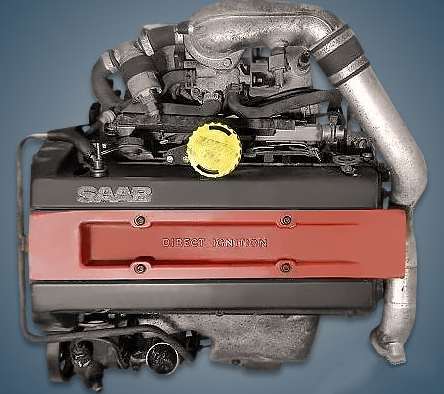
B204E, B204i, B204L, and B205E are 2.0-liter H-series engines.
Specifications
| Production years | 1994-2000 |
| Displacement, cc | 1985 |
| Fuel system | distributed injection |
| Power output, hp | 150 – 154 |
| Torque output, Nm | 219 |
| Cylinder block | cast iron R4 |
| Block head | aluminum 16v |
| Cylinder bore, mm | 90 |
| Piston stroke, mm | 78 |
| Compression ratio | 9.2 |
| Features | Trionic 5 |
| Hydraulic lifters | yes |
| Timing drive | chain |
| Phase regulator | no |
| Turbocharging | Garrett TB25 |
| Recommended engine oil | 5W-30 |
| Engine oil capacity, liter | 4.0 (together with an oil change in the cooler, 5.4 liters are needed) |
| Fuel type | petrol |
| Euro standards | EURO 2/3 |
| Fuel consumption, L/100 km (for Saab 9000 1997) — city — highway — combined |
12.3 6.7 8.7 |
| Engine lifespan, km | ~300 000 |
The engine was installed on:
- Saab 9000 I in 1994 – 1998;
- Saab 9-3 I (YS3D) in 1998 – 2000.
Disadvantages of the Saab B204E engine
Breakdowns occur at high mileage, but this turbo engine is dependable and inventive;
The block of balancers is the design’s weak point, and many people just remove it;
The ignition cassette may burn out if the spark plugs are not changed frequently;
Near 250,000 km, the timing chain is stretched and the oil pump typically requires maintenance;
There have been a few documented instances of connecting rod caps being unscrewed, which is fatal for the engine.