
From 1996 until 2014, the company produced the 1.2-liter 8-valve Renault D7F engine, which was fitted to its smallest models, including the Twingo, Clio, and Kangoo. A 1.0-liter version of this engine with the D7D index was available in the Brazilian market.
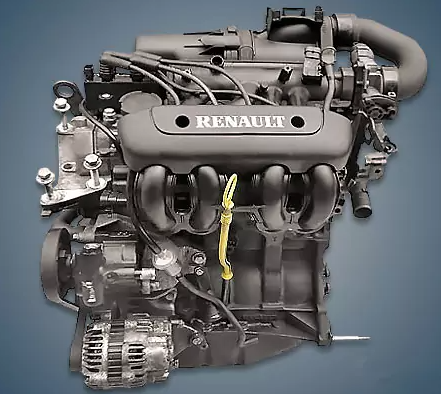
D4F and D4Ft are also part of the D-series.
Renault engineers unveiled a small engine for the Twingo model in 1996. This engine featured a single ignition coil, an 8-valve cylinder head without hydraulic lifters, an in-line cast-iron 4-cylinder block, and a timing belt drive despite its compact size. In contrast to older engines with single injection, this one uses distributed fuel injection.
Following the 2001 update, the engines 702, 703, and 704 marginally increased power to 60 horsepower. The initial power units with indices 700 and 701 produced 58 horsepower and 93 Nm of torque. A particularly cost-effective gas version with a torque reduction to 88 Nm was installed on the Clio 2, while the original generation Clio model had a 730 modification derated to 54 hp.
The engine was mounted on:
- Renault Clio 1 (X57) in 1996 – 1998; Clio 2 (X65) in 1998 – 2006; Clio 2 Campus in 2006 – 2012;
- Renault Kangoo 1 (KC) in 1997 – 2001;
- Renault Twingo 1 (C06) in 1996 – 2007; Twingo 2 (C44) in 2007 – 2014.
Specifications
| Production years | 1996-2014 |
| Displacement, cc | 1149 |
| Fuel system | injector |
| Power output, hp | 58 – 60 54 (deforced ver.) |
| Torque output, Nm | 88 – 93 93 (deforced ver.) |
| Cylinder block | cast iron R4 |
| Block head | aluminum 8v |
| Cylinder bore, mm | 69 |
| Piston stroke, mm | 76.8 |
| Compression ratio | 9.5 |
| Hydraulic lifters | no |
| Timing drive | belt |
| Turbocharging | no |
| Recommended engine oil | 5W-30, 5W-40 |
| Engine oil capacity, liter | 4.8 |
| Fuel type | petrol |
| Euro standards | EURO 2/3/4 |
| Fuel consumption, L/100 km (for Renault Twingo 2000) — city — highway — combined |
7.6 4.8 5.8 |
| Engine lifespan, km | ~300 000 |
| Weight, kg | 82 |
Disadvantages of the Renault D7F engine
Electrical malfunctions are the most common cause of concern for owners of a generally dependable unit; in this case, the temperature, throttle position, and air flow sensors malfunction.
The engine’s valves will bend if the belt bursts before the recommended 120,000 kilometers, according to the manuals. As a result, it is advisable to routinely assess its condition.
Unadjusted valves are typically the source of loud noises under the hood; to fix them, remove the valve cover, intake manifold, and gaskets.
This power unit’s attachments don’t have the best resources; lubricant leaks and overheating frequently result from the cooling system fan failing.