
From 1999 to 2008, the company assembled and installed the 2.2-liter Renault G9T or 2.2 DCI diesel engine on top models, including Laguna, Vel Satis, and Espace minivans. For the Master minibus and its replicas, a modified version of this diesel engine was available.
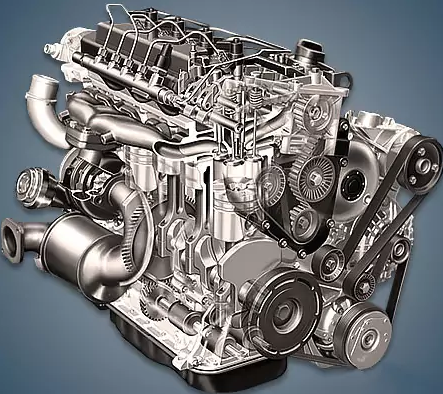
The G8T and G9U are also part of the G-series diesel line.
A 2.2-liter engine debuted on the second-generation Renault Master minibus in 1999. It was one of the first Common Rail diesels produced by the company, and it had a rather peculiar timing: the crankshaft used gears, one of which had a belt pulley that rotated the camshafts, to rotate the pump and injection pump. Here, a separate chain from the crankshaft powered the oil pump. A block of balancer shafts was also included in the pallet of the majority of this engine’s modifications.
Other than that, it is a CR diesel with a Garret GT1852V variable geometry turbine, a cast-iron block, a 16-valve head, and a Bosch CP1 or CP3 fuel system, depending on the version.
The engine was mounted on:
- Renault Avantime 1 (D66) in 2002 – 2003;
- Renault Espace 3 (J66) in 2000 – 2002; Espace 4 (J81) in 2002 – 2007;
- Renault Laguna 2 (X74) in 2002 – 2007;
- Renault Master 2 (X70) in 1999 – 2006;
- Renault Vel Satis 1 (B73) in 2002 – 2008;
- Nissan Interstar 1 (T35) in 2002 – 2003; Interstar 2 (X70) in 2003 – 2005;
- Opel / Vauxhall Movano A (X70) in 1999 – 2006.
Specifications
| Production years | 1999-2008 |
| Displacement, cc | 2188 |
| Fuel system | Common Rail |
| Power output, hp | 115 – 150 90 (minibus version) |
| Torque output, Nm | 290 – 320 260 (minibus version) |
| Cylinder block | cast iron R4 |
| Block head | aluminum 16v |
| Cylinder bore, mm | 87 |
| Piston stroke, mm | 92 |
| Compression ratio | 18.0 17.8 (minibus version) |
| Hydraulic lifters | yes |
| Timing drive | combined |
| Turbocharging | Garret GT1852V |
| Recommended engine oil | 5W-30, 5W-40 |
| Engine oil capacity, liter | 7.2 |
| Fuel type | diesel |
| Euro standards | EURO 3/4 |
| Fuel consumption, L/100 km (for Renault Espace 2003) — city — highway — combined |
10.3 6.3 7.7 |
| Engine lifespan, km | ~300 000 |
| Weight, kg | 227 |
Disadvantages of the Renault G9T engine
The springs in the combined timing drive frequently burst due to an unreliable mechanism for adjusting the gap between the gears. The gears grind off as a result, and pieces of them fall into the oil pan. Additionally, it may result in bent valves.
The turbocharger shaft or its seals may wear out on runs longer than 100,000 kilometers, at which point the turbine will start forcing lubricant into the intake. This is dangerous not only because the oil level will drop, but also because it may enter the combustion chamber and cause the engine to go into overdrive.
Apart from the turbine, the oil pump is frequently the cause of the system’s decreased lubrication level. It hangs the pressure-reducing valve in addition to wearing out the shaft and gears. Additionally, once the liners have been turned, the oil pressure light typically illuminates.
The majority of service calls are related to electrical malfunctions, which are typically caused by damaged wiring. The generator frequently fails here as well.
This diesel engine has a number of vulnerabilities and is well-known for frequent oil leaks. Grease typically seeps through the timing gears or from beneath the valve cover.