
First unveiled at the 1998 salon, the 1.6-liter 16-valve Renault K4M engine is currently being manufactured at a plant in Spain, Turkey, and AvtoVAZ since 2009. A sports version of the RS and a version of the motor with and without a phase regulator are both available.
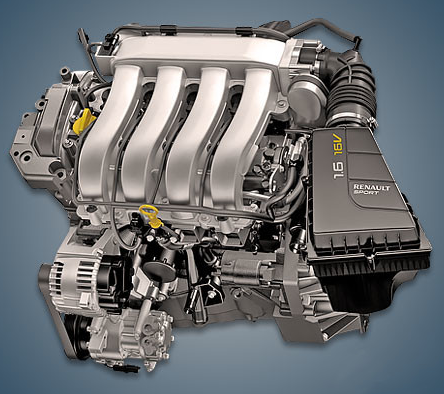
The K-series consists of K4J, K7J, K4M, K7M, and K9K.
A 16-valve engine joined the Renault K-series powertrain lineup in 1998. This motor was equipped with individual ignition coils, a phase regulator on the intake shaft in certain versions, and a new block head with two camshafts and hydraulic lifters. For Clio GT models, there was a forced version of the K4M RS in addition to Wind or Twingo RS.
Such an engine is similar to its 8-valve predecessors in every other way: it has a timing belt drive, an in-line cast-iron cylinder block, and distributed fuel injection. Initially, this motor was only assembled at the company’s Valladolid, Spain, plant. Later, an enterprise in Turkish Bursa was added, and in 2009, Togliatti AvtoVAZ.
Specifications
| Production years | since 1998 |
| Displacement, cc | 1598 |
| Fuel system | injector |
| Power output, hp | 90 – 105 (without phase regulator) 105 – 115 (with phase regulator) 128 – 133 (sports version) |
| Torque output, Nm | 140 – 150 (without phase regulator) 145 – 155 (with phase regulator) 155 – 160 (sports version) |
| Cylinder block | cast iron R4 |
| Block head | aluminum 16v |
| Cylinder bore, mm | 79.5 |
| Piston stroke, mm | 80.5 |
| Compression ratio | 9.5 – 9.8 (without phase regulator) 9.8 – 10.0 (with phase regulator) 11.0 (sports version) |
| Hydraulic lifters | yes |
| Timing drive | belt |
| Phase regulator | no yes |
| Recommended engine oil | 5W-30, 5W-40 |
| Engine oil capacity, liter | 4.8 |
| Fuel type | petrol |
| Euro standards | EURO 4/5 |
| Fuel consumption, L/100 km (for Renault Logan 2015) — city — highway — combined |
9.4 5.8 7.1 |
| Engine lifespan, km | ~400 000 |
| Weight, kg | 133 |
The engine was installed on:
- Renault Clio 2 (X65) in 1998 – 2005; Clio 3 (X85) in 2005 – 2013;
- Renault Duster 1 (HS) in 2010 – 2015;
- Renault Fluence 1 (L38) in 2009 – 2016;
- Renault Kangoo 1 (KC) in 2001 – 2009; Kangoo 2 (KW) in 2008 – 2014;
- Renault Laguna 1 (X56) in 1998 – 2001; Laguna 2 (X74) in 2001 – 2007; Laguna 3 (X91) in 2007 – 2010;
- Renault Logan 1 (L90) in 2009 – 2016; Logan 2 (L52) since 2012;
- Renault Logan 2 Stepway (L52S) since 2018;
- Renault Megane 1 (X64) in 1999 – 2003; Megane 2 (X84) in 2002 – 2009; Megane 3 (X95) in 2008 – 2014;
- Renault Sandero 1 (B90) in 2009 – 2014; Sandero 2 (B52) in 2012;
- Renault Sandero 1 Stepway (B90S) in 2009 – 2014; Sandero 2 Stepway (B52S) since 2014;
- Renault Scenic 1 (J64) in 1999 – 2003; Scenic 2 (J84) in 2003 – 2009; Scenic 3 (J95) in 2009 – 2016;
- Renault Symbol 1 (L65) in 2002 – 2008; Symbol 2 (L35) in 2008 – 2013;
- Renault Twingo 2 (C44) in 2008 – 2013;
- Renault Wind 1 (E33) in 2010 – 2013;
- Dacia Duster 1 (HS) in 2010 – 2018;
- Dacia Logan 1 (L90) in 2005 – 2013; Logan 1 MCV (R90) in 2006 – 2013;
- Dacia Sandero 1 (B90) in 2010 – 2012; Sandero 1 Stepway (B90x) in 2010 – 2012;
- Nissan Almera RUS (G15) in 2012 – 2019;
- Nissan Terrano 3 (D10) in 2014 – 2016;
- Lada Largus Cross in 2014 – 2017; Largus station wagon in 2012 – 2017; Largus van in 2015 – 2017.
Disadvantages of the Renault K4M engine
He is the weak point in the modifications made to this motor with a phase regulator. It can occasionally begin to crack at 60,000 kilometers, and replacing it can be costly.
The timing belt is supposed to be changed every 60,000 kilometers, but it actually takes longer. It usually breaks because of the tensioner roller or the pump wedge. Simultaneously, the valves are bent.
Owners of vehicles with these engines frequently deal with floating rpm. Contamination of the throttle, injectors, or idle speed controller could be the cause. Air leaks through intake manifold cracks are frequently the cause.
This line’s power units are all vulnerable to coolant or oil leaks. The oil separator, crankshaft front oil seal, and valve cover are the primary weak points. Most frequently, antifreeze seeps through the thermostat housing’s cracks.
Additionally, this power unit’s pillows, crankshaft position sensor, ignition coils, and crankshaft damper pulley are not the best resources.