
From 2007 to 2013, the Renault D4Ft 1.2-liter turbo engine, also known as the 1.2 TCe 100, was manufactured and installed in the company’s compact models, including the Twingo, Clio, Modus, and Wind. In essence, this power unit is a turbocharged version of the widely used D4F engine.
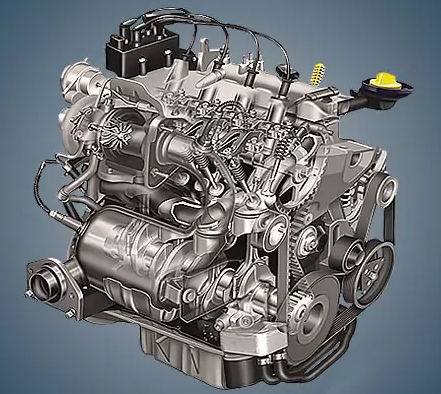
The engines in the TCe line are H4Bt, H4Dt, H5Dt, D4Ft, H5Ft, H5Ht, H4Jt, M5Mt, M5Pt, and F4Rt.
The Clio 3 model introduced a new turbo engine based on the popular D4F unit in 2007. In addition to adding a turbine with an intercooler to a traditional engine, the engineers also added an additional cylinder head, a heavily reinforced connecting rod and piston group, and oil nozzles to cool the pistons. The old engine still had a timing belt drive, a distributed fuel injection system, a single camshaft that controlled sixteen valves, and an in-line cast-iron block for four cylinders.
Four variations of these power units are the most common:
- 780 for 74 kW or 101 hp, 145 Nm were installed on Twingo (2007 – 2011), Wind (2010 – 2011);
- 782 for 75 kW or 102 hp, 155 Nm were installed on Twingo (2011 – 2013), Wind (2011 – 2013);
- 784 for 74 kW or 101 hp, 145 Nm was installed on Clio (2007 – 2011), Modus (2007 – 2011);
- 786 for 76 kW or 103 hp, 155 Nm was installed on Clio (2011 – 2012), Modus (2011 – 2012).
Specifications
| Production years | 2007-2013 |
| Displacement, cc | 1149 |
| Fuel system | injector |
| Power output, hp | 100 – 103 |
| Torque output, Nm | 145 – 155 |
| Cylinder block | cast iron R4 |
| Block head | aluminum 16v |
| Cylinder bore, mm | 69 |
| Piston stroke, mm | 76.8 |
| Compression ratio | 9.5 |
| Hydraulic lifters | no |
| Timing drive | belt |
| Turbocharging | yes |
| Recommended engine oil | 5W-30, 5W-40 |
| Engine oil capacity, liter | 4.8 |
| Fuel type | petrol |
| Euro standards | EURO 4/5 |
| Fuel consumption, L/100 km (for Renault Clio 2010) — city — highway — combined |
7.9 5.2 6.3 |
| Engine lifespan, km | ~300 000 |
| Weight, kg | 91 |
The engine was installed on:
- Renault Clio 3 (X85) in 2007 – 2012;
- Renault Modus 1 (J77) in 2007 – 2012;
- Renault Twingo 2 (C44) in 2007 – 2013;
- Renault Wind 1 (E33) in 2010 – 2013.
Disadvantages of the Renault D4Ft engine
The majority of this motor’s issues are caused by the whims of electricians, despite its high level of dependability. Here, sensors typically malfunction along with an expensive ignition coil.
The timing belt is supposed to change every 120,000 kilometers, but it can break even sooner, according to the handbook. Because the valves in this motor always bend when it breaks, keep an eye on its condition.
Unadjusted valves are the primary source of loud noises under the hood. Both the intake manifold and the valve cover must be removed in order to adjust them.
Even in this unit, the fuel pump is unreliable, attachments frequently break, and lubricant and coolant leaks are fairly frequent.