
From 1988 until 2006, the company’s plant assembled the 1.9-liter Renault F8Q diesel engine, which was fitted to vehicles like the Kangoo, Clio, Megan, Scenic, Mitsubishi Carisma, and Volvo S40. There was a 64-hp atmospheric version and a 90-hp turbocharged version of the engine.
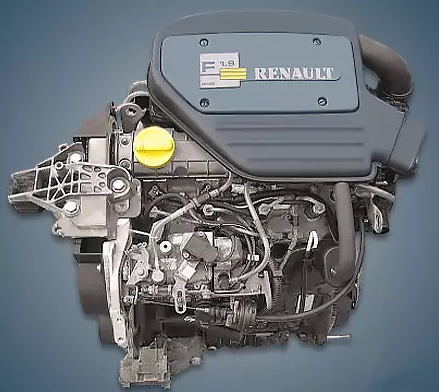
F8M, F9Q, and F9Qt are additional F-series diesels.
The 1.9-liter atmospheric diesel engine, which was actually a modernization of the 1.6-liter F8M prechamber engine, made its debut on the Renault 19 model in 1988. Although the Kangoo model has a 1.9-liter engine derated to 54 horsepower, the updated engine’s power has increased from 54 to 64 horsepower due to the increased displacement. Everything else stayed the same: a timing belt drive, a mechanical injection pump from Bosch, Lucas, or Delphi, and a cast-iron block with an aluminum 8-valve cylinder head without hydraulic lifters.
A year later, a 90 horsepower supercharged diesel engine with a Garrett GT1544S turbine was introduced. This unit was installed on several of the company’s well-known models in the 1990s. Over time, a more advanced turbine and an electronically operated injection pump emerged, and the motor was continuously improved. Up until 2006, Dacia vehicles had F8Q engines.
The engine was mounted on:
- Renault 19 (X53) in 1988 – 1995;
- Renault 21 (L48) in 1989 – 1993;
- Renault Clio 1 (X57) in 1991 – 1998; Clio 2 (X65) in 1998 – 2001;
- Renault Express 1 (X40) in 1994 – 1998;
- Renault Kangoo 1 (KC) in 1997 – 2003;
- Renault Megane 1 (X64) in 1996 – 2000;
- Renault Scenic 1 (J64) in 1996 – 2000;
- Renault Trafic 1 (TXW) in 1997 – 2001;
- Dacia Solenza 1 (B41) in 2003 – 2005; Pick-Up 1 (X41) in 2002 – 2006;
- Mitsubishi Carisma 1 (DA) in 1996 – 2000;
- Volvo 440 in 1993 – 1996; 460 in 1993 – 1996; S40 I (644) in 1995 – 1999; V40 I (645) in 1995 – 1999 (as D19T204 or D4192T).
Specifications
| Production years | 1988-2006 |
| Displacement, cc | 1870 |
| Fuel system | prechambers |
| Power output, hp | 54 – 64 (atmospheric) 90 (turbocharged) |
| Torque output, Nm | 118 – 120 (atmospheric) 175 – 180 (turbocharged) |
| Cylinder block | cast iron R4 |
| Block head | aluminum 8v |
| Cylinder bore, mm | 80 |
| Piston stroke, mm | 93 |
| Compression ratio | 21.5 (atmospheric) 20.5 (turbocharged) |
| Hydraulic lifters | no |
| Timing drive | belt |
| Recommended engine oil | 5W-40, 10W-40 |
| Engine oil capacity, liter | 5.9 |
| Fuel type | diesel |
| Euro standards | EURO 1/2 |
| Fuel consumption, L/100 km (for Renault Kangoo 1997) — city — highway — combined |
8.2 6.0 6.8 |
| Engine lifespan, km | ~500 000 |
| Weight, kg | 163 |
Disadvantages of the Renault F8Q engine
Head cracking is the most well-known issue with this diesel engine. Nearly all motors have cracks, and frequent overheating only makes them more noticeable.
A Lucas fuel pump was installed in the majority of this engine’s modifications. The most frequent issue he has is an injection advance valve leak.
The battle against air leaks lasts the entire life of the owner of a vehicle with such a diesel engine. The integrity of the fuel filter housing and all pipes must be continuously inspected.
This engine is leaking something all the time. Antifreeze typically seeps from the thermostat housing, and grease typically seeps from beneath the heat exchanger and valve cover. Oil is frequently driven by the turbine as well.
The EGR valve is frequently clogged, the flow-through fuel heater malfunctions, and many other issues are brought on by erratic sensors, especially their poor wiring.