
From 1983 until 2002, the company produced the 1.6-liter Toyota 4A-GE gasoline engine, which was fitted to a number of well-known concern models, including the Carina, Celica, and Corolla Levin. This power unit is conditionally divided into five generations based on a number of modifications.
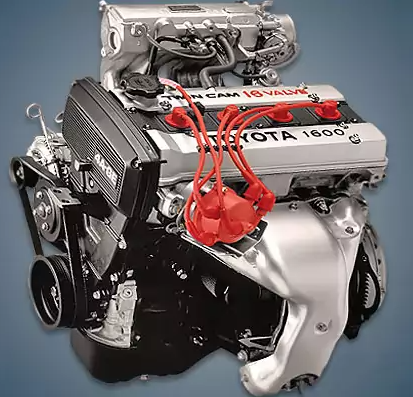
The engines 8A-FE, 5A-FE, 5A-FHE, 4A-FE, 4A-FHE, 4A-GE, 4A-GZE, and 7A-FE are also members of the A family.
Yamaha engineers created the aluminum 16-valve block head of the new, sporty engine that made its debut on the fifth generation Corolla in 1983. Other than that, it was an entirely traditional 4-cylinder engine with a timing belt drive, a cast-iron block, and no hydraulic lifters. Therefore, the valves must be adjusted.
The engine comes in two versions with 16 and 20 valve cylinder heads, but the majority are categorized into five generations:
- The first generation, known as Blue Top or Early Bigport, has a silver valve cover with the words Twin Cam 16 VALVE written simultaneously in black and blue letters. From 1983 to 1987, models of this unit were produced for the American and Japanese markets. The motor developed between 110 and 130 horsepower and had a T-VIS adjustable air intake system.
- The second generation, also known as the Red & Black Top or Late Bigport, was manufactured between 1987 and 1992 and could be identified externally by the red and black lettering on the lid. Work was done to strengthen the structure even though the power did not increase: more stiffeners were added to the cylinder block,
- Only from 1989 to 1991 was the third generation, also known as Red Top or Smallport, manufactured. The inscription “Twin cam 16 valve made only in red letters” allowed for its identification. The T-VIS system was eliminated because this engine had fewer intake channels. Additionally, the connecting rod and piston group were altered because the compression ratio was raised from 9.4 to 10.3, and oil nozzles were added to cool the pistons. The power was raised to 140 horsepower.
- The fourth generation, also known as the Silver Top, had a new 20-valve cylinder head and was identified by a gray cover painted in silver with the TWIN CAM 20 inscription. Only Japanese models were equipped with this type of power unit, which was manufactured between 1991 and 1995. The engine had a sophisticated intake system with four throttles and a VVT phase regulator on the intake shaft in addition to the 20-valve cylinder head. The engine’s power was increased to 160 horsepower as a result.
- The black plastic valve cover is a distinguishing feature of the fifth generation, also known as Black Top. These engines are exclusive to Japanese models and were manufactured between 1995 and 2002. The unit was able to produce 165 horsepower, which is the maximum for the line, by slightly increasing the diameter of the throttles, camshaft cams, and compression ratio from 10.5 to 11.0.
The engine was mounted on:
- Toyota Carina 3 (A60) in 1983 – 1985; Carina 4 (T150) in 1984 – 1988; Carina 5 (T170) in 1987 – 1992; Carina 7 (T210) in 1996 – 2001;
- Toyota Celica 3 (A60) in 1983 – 1985; Celica 4 (T160) in 1985 – 1989;
- Toyota Corolla 5 (E80) in 1983 – 1987; Corolla 6 (E90) in 1987 – 1992; Corolla 7 (E100) in 1991 -1998; Corolla 8 (E110) in 1995 – 2002;
- Toyota Corona 7 (T140) in 1983 – 1985; Corona T160 in 1985 – 1988;
- Toyota MR2 1 (W10) in 1984 – 1989;
- Toyota Sprinter 5 (E80) in 1983 – 1987; Sprinter 6 (E90) in 1987 – 1992; Sprinter 7 (E100) in 1992 – 1995; Sprinter E110 in 1995 – 2000.
Specifications
| Production years | 1983-2002 |
| Displacement, cc | 1587 |
| Fuel system | injector |
| Power output, hp | 110 – 140 (16 valve versions) 160 – 165 (20 valve versions) |
| Torque output, Nm | 130 – 150 (16 valve versions) 160 – 165 (20 valve versions) |
| Cylinder block | cast iron R4 |
| Block head | aluminum 16v aluminum 20v |
| Cylinder bore, mm | 81 |
| Piston stroke, mm | 77 |
| Compression ratio | 9.4 – 10.3 (16 valve versions) 10.5 – 11.0 (20 valve versions) |
| Hydraulic lifters | no |
| Timing drive | belt |
| Turbocharging | no |
| Recommended engine oil | 5W-30, 5W-40 |
| Engine oil capacity, liter | 3.2 |
| Fuel type | petrol |
| Euro standards | EURO 2 |
| Fuel consumption, L/100 km (for Toyota Corolla Levin 1998) — city — highway — combined |
9.3 5.8 7.5 |
| Engine lifespan, km | ~300 000 |
| Weight, kg | 135 |
Disadvantages of the 4A-GE engine
Although Toyota A-series engines are dependable and have no design flaws, there is a knock of piston pins from working out after more than 100,000 kilometers. Check the valve clearances before making a repair because they frequently knock.
Electrical issues frequently arise, and sensors are thought to be the engine’s weak point. A burned-out lambda probe is typically the cause of an abrupt spike in fuel consumption. If the temperature sensor malfunctions, the car will frequently stall or not start at all, and the engine speed will float as a result of issues with the absolute pressure sensor and throttle position.
Piston rings or valve stem seals frequently wear out after 200,000 kilometers, and oil consumption can eventually increase to one liter per 1000 kilometers.
This engine is always worrying about small things, and it’s not about dependability but rather its age. The engine begins to triple due to clogged nozzles or a throttle caused by poor fuel. Both the antiquated ignition system and the crankshaft oil seal frequently leak oil.