
From 1986 to 2003, the company assembled and installed the 2.0-liter 16-valve Toyota 3S-FE engine on numerous models, including the Celica, Camry, Carina, and Caldina. With good reason, this power unit is regarded as one of the most dependable engines of its era.
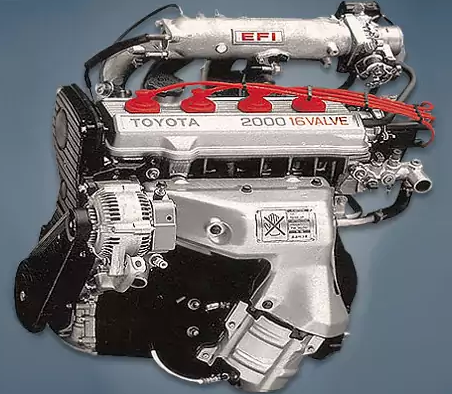
The Camry V20 was the first vehicle to use this EFI multiport fuel injection system in 1986. The classic design consists of a timing belt drive, a 16-valve aluminum cylinder head, a 4-cylinder cast-iron block, and a valve that must be adjusted because there are no hydraulic compensators.
This incredibly popular engine has undergone numerous significant updates since it was first introduced, and the 1986, 1991, and 1996 versions differ significantly from one another. The timing, intake manifold, camshafts, connecting rod and piston group, and ignition system have all been updated.
The engines in the S family are 4S-Fi, 4S-FE, 3S-FC, 3S-FE, 3S-FSE, 3S-GE, 3S-GTE, and 5S-FE.
The engine was mounted on:
- Toyota Avensis 1 (T220) in 1997 – 2003;
- Toyota Caldina 1 (T190) in 1992 – 2002; Caldina 2 (T210) in 1997 – 2002;
- Toyota Camry 2 (V20) in 1986 – 1992; Camry V30 in 1990 – 1994; Camry V40 in 1994 – 1998;
- Toyota Carina 5 (T170) in 1987 – 1992; Carina 6 (T190) in 1992 – 1998;
- Toyota Celica 4 (T160) in 1986 – 1989; Celica 5 (T180) in 1989 – 1993; Celica 6 (T200) in 1993 – 1999;
- Toyota Corona 9 (T170) in 1987 – 1992; Corona 10 (T190) in 1992 – 1998;
- Toyota Picnic 1 (XM10) in 1995 – 2001;
- Toyota RAV4 1 (XA10) in 1994 – 2003;
- Toyota Vista 5 (V50) in 1998 – 2003.
Specifications
| Production years | 1986-2003 |
| Displacement, cc | 1998 |
| Fuel system | injector |
| Power output, hp | 115 – 140 |
| Torque output, Nm | 165 – 185 |
| Cylinder block | cast iron R4 |
| Block head | aluminum 16v |
| Cylinder bore, mm | 86 |
| Piston stroke, mm | 86 |
| Compression ratio | 9.8 |
| Hydraulic lifters | no |
| Timing drive | belt |
| Recommended engine oil | 5W-30, 5W-40 |
| Engine oil capacity, liter | 3.9 |
| Fuel type | petrol |
| Euro standards | EURO 2 |
| Fuel consumption, L/100 km (for Toyota Caldina 2000) — city — highway — combined |
11.5 6.8 8.4 |
| Engine lifespan, km | ~500 000 |
| Weight, kg | 145 |
Disadvantages of the Toyota 3S-FE engine
- failure of the injection pump. The issue is accompanied by high ShPG wear and fuel penetration into the crankcase. Symptoms include an increase in gasoline-smelling oil, twitching while driving, engine stalling on occasion, uneven stroke, and swimming speed. The injection pump needs to be replaced.
- EGR valve stuck. Poor fuel is the cause of the coking. Consequently, the engine fails, the number of revolutions floats, and the vehicle is unable to operate. needs to have its valves cleaned.
- unit shutdown and a decrease in speed. Both the intake manifold and the throttle valve module need to be cleaned. A fuel pump and air filter failure is a comparable symptom.
- excessive use of fuel. The BDZ, the idle speed control valve, the injectors, and the ignition system must all be cleaned.
- vibrations. One of the cylinders failing or the engine mountings wearing out are the causes.
- overheating. Put the radiator cap back on.
Overall, the unit is not too bad; it exhibits agility and stability. It provides excellent service over 300,000 kilometers. The 3S-FE engines, which went into production in August 1996, have a worse resource. Lightweight pistons and connecting rods were added to these engines, while the 1988 model’s crankshaft stayed the same.
High fuel consumption
The most common cause of high fuel consumption on the 3S-FE engine is a lambda probe malfunction. Less frequently, an intake air sensor malfunction is found in the air filter housing. Or the MAP sensor could be the culprit, ie. absolute pressure sensor.
Throttle and idle valve
The 3S-FE engine’s throttle valve has a cable drive and, in later iterations, a throttle position sensor. The engine is idled using an electronic idle speed controller. Remember that he made it possible for the air required for the engine to idle to pass through the idle speed controller channel when the mechanical damper is fully closed.
Cleaning the regulator is typically the solution to idle issues with a 3S-FE engine.
This engine’s throttle valve is tainted with soot and oil vapor. The crankcase ventilation system’s ineffective screening out of oil vapors causes them to appear in the intake. Additionally, the EGR system is the source of soot. Engine responses are significantly improved after the throttle body has been cleaned.
Dual ignition coils
The 3S-FE engine’s ignition system has been improved since August 1996. Two dual ignition coils—each of which serves two candles—were installed in place of a distributor. As a result, every candle emits a spark twice in four working cycles. As a result, there is more strain on the candles and high-voltage cables.
This proved to be true in practice: coil ignition on the 3S-FE engine required twice as much maintenance as the distributor system. In other words, if high-voltage wires that had previously lasted longer than ten years were combined with this coil, their lifespan was shortened to five or six years. Additionally, the mechanical ignition distributor proved to be more durable than the coils themselves.
EGR system
The 3S-FE engine has always been equipped with the EGR system. The three modes of operation of the system concentrate on engine load and temperature. Until the operating temperature and full throttle (maximum load) are reached, there is no exhaust gas recirculation. Gas recirculation is minimal at low loads, such as when driving slowly. When driving on a highway, for instance, the maximum intake of exhaust gases takes place at a constant speed and average load.
For flexible recirculation control, an electro-vacuum valve is utilized. It is basically a housing with a membrane that regulates the EGR valve via a vacuum modulator rather than directly. The EGR valve is opened by vacuum and closed by pressure. those. The EGR valve is closed by default.
The electrovacuum valve in this system on the 3S-FE engine fails most frequently. As a result, the engine begins to work hard, detonating at medium loads between 1500 and 2500 rpm. those. The air-fuel mixture’s combustion temperature is significantly raised because exhaust gases are not supplied to the intake.
It is possible to check the electrical resistance of the electrovacuum valve, which is situated at the bottom of the intake manifold; the values should be between 33 and 39 ohms.
You must “purge” the modulator in order to verify. It is blown “through” on an idle engine up to 2500 rpm, meaning that air will leave through ports P and R. Air cannot pass through the modulator at speeds higher than 2500 rpm.
With the engine running, the EGR valve is examined. To accomplish this, disconnect the valve’s tube, attach a hand vacuum pump in its place, and generate a vacuum. All parts are operating correctly if the engine becomes unstable and even stalls as the vacuum at the Q input rises.
Additionally, the vacuum modulator housing has a filter that allows small amounts of exhaust gases to pass through and be “cleaned” before entering the tube when the EGR valve is closed. Every few years, this filter needs to be cleaned; compressed air works well for this.
Injectors
The 3S-FE engine starts erratically when it’s hot or cold due to clogged fuel injectors. The initial issues are resolved by replacing them.
Crankcase ventilation
The 3S-FE engine’s crankcase ventilation system does a poor job of separating gases from oil vapors. As a result, oil vapors collect on the throttle valve and in the intake manifold. Some owners install an external oil separator or even two oil separators to capture oil vapors.
The valve cover contains the standard oil separator, which takes the shape of a labyrinth. It sends its crankcase gases to the intake via two channels, one before and one after the throttle. The engine has an oil appetite—that is, he “uses” the oil vapor that enters the intake manifold—because there are so many deposits in the labyrinth that oil sifting essentially stops. Additionally, it is not unnecessary to check the check valve in the gas supply tube behind the throttle. Maybe it should be cleaned, or better yet, replaced.