
Since 2010, the company’s Japanese plant has been assembling the 1.5-liter Toyota 2NR-FE engine. There are two versions of the motor available: one with and one without the Dual VVT-i phase control system. Two Chinese 5NR-FE and 7NR-FE, as well as bioethanol 2NR-FBE, have different modifications.
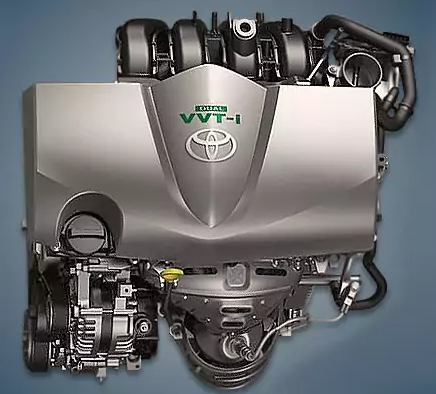
The engines in the NR family are 3NR-FE, 8NR-FTS, 1NR-FE, 1NR-VE, 1NR-FKE, 2NR-FE, 2NR-VE, and 2NR-FKE.
The engine was mounted on:
- Toyota Etios NGK15 since 2010;
- Toyota Etios Cross NGK12 since 2014;
- Toyota Sienta XP170 since 2016;
- Toyota Vios XP150 since 2016;
- Toyota Yaris XP150 since 2016.
Specifications
| Production years | since 2010 |
| Displacement, cc | 1496 |
| Fuel system | injector MPI |
| Power output, hp | 90 (non Dual VVT-i) 107 (Dual VVT-i) |
| Torque output, Nm | 132 (non Dual VVT-i) 140 (Dual VVT-i) |
| Cylinder block | aluminum R4 |
| Block head | aluminum 16v |
| Cylinder bore, mm | 72.5 |
| Piston stroke, mm | 90.6 |
| Compression ratio | 10.5 (non Dual VVT-i) 11.5 (Dual VVT-i) |
| Features | ETCS-i |
| Hydraulic lifters | no (non Dual VVT-i) yes (Dual VVT-i) |
| Timing drive | chain |
| Phase regulator | no Dual VVT-i |
| Turbocharging | no |
| Recommended engine oil | 5W-20 |
| Engine oil capacity, liter | 3.4 |
| Fuel type | petrol |
| Euro standards | EURO 3/4 (non Dual VVT-i) EURO 4/5 (Dual VVT-i) |
| Fuel consumption, L/100 km (for Toyota Vios 2016) — city — highway — combined |
6.5 4.7 5.2 |
| Engine lifespan, km | ~200 000 |
| Weight, kg | 98 |
Disadvantages of the 2NR-FE engine
A minor oil burn is equally likely to occur in both engine versions.
Individual ignition coils and a water pump are quickly given up.
In cold weather, the motor occasionally won’t start and is rather noisy.