
Six-cylinder inline engines make up the Toyota G series. This series’ engines were manufactured between 1979 and 2006. Every engine has the same 2-liter (1988 cc) displacement. A timing belt was used to drive the gas distribution system in every engine in the series.
1G-EU (1979–1988): The Toyota Crown featured the first 1G, which had a compression ratio of 8.8, 125 horsepower at 5400 rpm, and 160 Nm of torque at 4400 rpm. A version with a power of 130 horsepower and a compression ratio of 9.2 has been manufactured since 1983. 1986 saw a reduction in power to 105 horsepower at 5400 rpm and 146 Nm of torque at 4400 rpm. Toyota Chaser X60, Cresta X50/X60/X70, Crown S110, Mark 2 X60, and Soarer Z10/Z20 all had these engines installed.
1G-GEU (1983–1988): This model had a T-VIS variable geometry intake manifold and a Yamaha 24 valve cylinder head. These changes resulted in an increase in engine power to 160 horsepower at 6400 rpm and torque to 186 Nm at 5200 rpm. The 1G-GEU has been producing about 140 horsepower since 1985. It was fitted to the Toyota Chaser X70, Mark 2 X60/X70, Cresta X60/X70, Crown S120, Soarer Z10/Z20, and Toyota Supra A70.
1G-GTEU (1986–1988): a turbo version of the 1G-GEU with two CT12 turbochargers installed and a compression ratio lowered to 8.5. The 1G-GTEU was installed on the Toyota Chaser X70, Mark 2 X70, Cresta X70, Soarer Z20, and Toyota Supra A70. It generated 185 horsepower at 6200 rpm and 245 Nm of torque at 3200 rpm at 0.5 bar.
1G-GZEU/GZE (1986–1992) was a compressor version of 1G-GEU that substituted the SC-14 compressor for turbines. Electronic ignition was employed concurrently with an additional piston group for an 8 compression ratio. Such a power unit can produce 160 horsepower at 6000 rpm and 210 Nm of torque at 4000 rpm. The name was changed to 1G-GZE in 1989 after the engine was upgraded. 0.5 bar of boost pressure, 170 horsepower at 6000 rpm, and 230 Nm of torque at 3600 rpm. installed on the Crown S130, Soarer Z20, Toyota Chaser X80, Mark 2 X80, and Cresta X80.
1G-GE (1988–1993) was an upgraded 1G-GEU with an absolute pressure sensor in place of the mass air flow sensor, 150 horsepower at 6200 rpm, and 186 Nm of torque at 5400 rpm.Toyota Chaser X80, Mark 2 X80, Cresta X80, Crown S130, Soarer Z20, and Supra A70 all have 1G-GE installed.
1G-GTE (1988–1991): an improved 1G-GTEU with a reinforced crankshaft, a new intake, an intercooler, 315 cc injectors, and an ECU. The boost pressure rose to 0.75 bar. The engine produces 210 horsepower at 6200 rpm and 275 Nm of torque at 3800 rpm. Except for the Toyota Crown, these motors are found on vehicles similar to the 1G-GE.
Designed to replace 1G-EU, 1G-FE (1988–2005) was a variant of 1G-GEU with a different narrow 24 valve cylinder head. 135 horsepower at 5600 rpm and 176 Nm of torque at 4400 rpm. installed on the Soarer Z20, Crown S140, Cresta X80/X90, and Toyota Mark 2 X90. Power has increased to 140 horsepower at 5750 rpm and 185 Nm of torque at 4400 rpm since a redesign in 1996. This engine is found in the Toyota Chaser X100, Mark 2 X100, Cresta X100, and Crown S150.
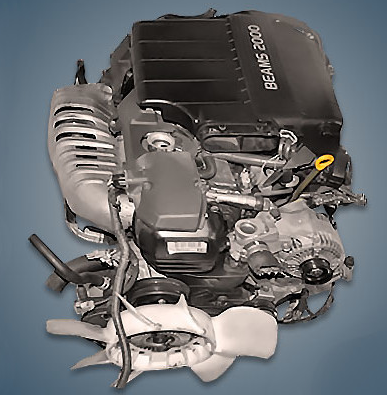
More significant modifications were made to 1G-FE in 1998, and the BEAMS prefix was added. A new connecting rod and piston group, an electronic throttle valve, an ACIS variable geometry intake manifold, a variable valve timing system on the intake shaft, modifications to the ignition system, and a finalized exhaust manifold were among the innovations that 1G received. Since the 1G-FE lacks hydraulic lifters, the clearances need to be checked every 20,000 kilometers.
In summary, 1G BEAMS now has a compression ratio of 10, 160 horsepower at 6200 rpm, and 200 Nm of torque at 4400 rpm. Toyota Mark 2 X100/X110, Chaser X100, Crown S150/S170, Verossa, Altezza, and Lexus IS 200 all had 1G-FE BEAMS installed.
Specifications
| Manufacturer | Shimoyama plant |
| Production years | 1979-2006 |
| Cylinder block alloy | cast iron |
| Fuel system | injector |
| Configuration | inline |
| Number of cylinders | 6 |
| Valves per cylinder | 2/4 |
| Piston stroke, mm | 75 |
| Cylinder bore, mm | 75 |
| Displacement, cc | 1988 |
| Fuel type | petrol |
| Euro standards | up to Euro 3 |
| Weight, kg | 180 (1G-EU, 1G-FE) 190 (1G-GE, 1G-GEU) 215 (1G-GTE, 1G-GTEU) 200 (1G-GZE, 1G-GZEU) |
| Fuel consumption, L/100 km — city — highway — combined |
14.0 7.8 9.8 |
| Oil consumption, gr/1000 km | up to 1000 |
| Recommended engine oil | 0W-30 / 5W-30 / 5W-40 / 10W-30 / 10W-40 / 10W-50 / 15W-50 |
| Engine oil capacity, liter | 4.2 |
| Oil change interval, km | 7000-10000 |
| Engine lifespan, km | from 300,000 to 400,000 depending on modification |
Frequent problems
Rapid engine oil consumption. The cause is the oil scraper rings sinking, which is a common occurrence in engines with high mileage. Replacing the piston rings, liners, valve stem seals, oil seals, and other components of the entire set will help with de-carbonization or repair.
leak of oil. occurs as a result of the pressure sensor’s wear. A new one must be purchased and installed.
instability of oil pressure. The sensor itself is the issue. It is necessary to measure the pressure and replace the sensor.
Turns are switched. The throttle position sensor, throttle valve, and idle valve must all be checked. There is a possibility that the final two won’t be installed properly if you reinstall them.
The long service life of turbochargers is the same even with modifications to turbocharged engines. After 100,000 kilometers, they must be replaced. Additionally, a subpar oil pump drive is installed. An engine generally needs high-quality oil. The valves on “Beams” modifications bend when the timing belt breaks. Although the motors are generally good, even the most recent FE models are already fairly old and worn out.