
The 2NZ engine is a 4-stroke, 4-cylinder gasoline engine with two overhead camshafts (typically with a variable valve timing system VVT-i), in-line cylinders and pistons rotating a single crankshaft, and an electronic fuel injection and ignition control system. A closed-type forced circulation liquid cooling system is installed in the engine. pressure and spray lubrication system combined.
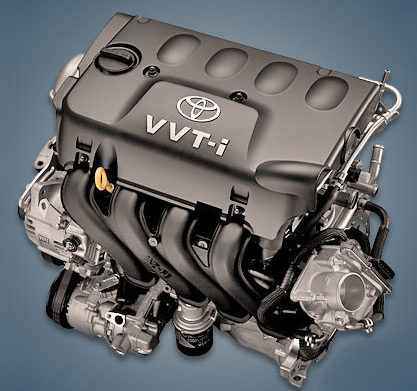
The introduction of Euro 4 emission standards in 2003 led to a redesign of the 2NZ-FE engine. The engine underwent the following modifications:
- the exhaust manifold’s shape,
- the piston’s shape,
- the three-way catalytic converter’s design,
- the three-way catalytic converter’s installation,
- and the ECU’s 32-bit configuration have all been altered.
The engines 1NZ-FE and 1NZ-FXE are also part of the NZ family.
The engine was mounted on:
- Toyota bB NCP3 in 2000 – 2005;
- Toyota Echo XP10 in 1999 – 2005;
- Toyota Ist XP60 in 2002 – 2007;
- Toyota Porte AP10 in 2004 – 2012; Porte XP140 since 2012;
- Toyota Yaris XP10 in 1999 – 2005; Yaris XP90 in 2005 – 2011; Yaris XP130 since 2011.
Specifications
| Production years | since 1999 |
| Displacement, cc | 1298 |
| Fuel system | injector MPI |
| Power output, hp | 80 – 90 |
| Torque output, Nm | 120 – 125 |
| Cylinder block | aluminum R4 |
| Block head | aluminum 16v |
| Cylinder bore, mm | 75 |
| Piston stroke, mm | 73.5 |
| Compression ratio | 10.5 |
| Features | ETCS-i since 2004 |
| Hydraulic lifters | since 2004 |
| Timing drive | chain |
| Phase regulator | VVT-i intake |
| Turbocharging | no |
| Recommended engine oil | 5W-30 |
| Engine oil capacity, liter | 3.7 |
| Fuel type | petrol |
| Euro standards | EURO 2/3/4 |
| Fuel consumption, L/100 km (for Toyota Yaris 2008) — city — highway — combined |
7.6 4.8 5.7 |
| Engine lifespan, km | ~250 000 |
| Weight, kg | 88 |
Disadvantages of the 2NZ-FE engine
increased use of oil. After roughly 150,000 kilometers, the issue is discovered. Decarbonizing or changing the rings and caps are two ways to fix it.
The motor makes noises. The timing chain stretching is the primary cause. It usually shows up after 200,000 kilometers. All that’s needed is a replacement. Check the chain tensioner and damper as well.
At idle, the engine’s speed varies. The throttle-valve module, detector, and valve at idle speed must all be cleaned.
The engine began to whistle. This is a sign that the alternator belt is cracked. All that’s needed is a replacement.
the unit’s vibrations. It must be done in order: replace the fuel filter, clean the injectors, and inspect the front cushion.
Additional issues include the oil pressure sensor failing, the rear oil seal on the crankshaft leaking, and the cylinder block not being able to be fixed. The motor usually changes after 200,000 kilometers. The Toyota 2NZ engine will last longer if high-quality engine oil is used.
Cylinder block
The Toyota 2NZ-FE features thin-walled cast iron liners and a five-bearing aluminum cylinder block. It has a stroke of 73.5 mm and a bore of 75.0 mm. The engine features an integrated crankshaft position sensor and a crankshaft with four counterweights.
Bolts from the plastic section hold the caps on the steel connecting rods of the 2NZ-FE engine in place. The engine has low voltage rings (two compressor rings and one oil control ring), semi-floating piston pins, and aluminum alloy pistons.
Cylinder head
The aluminum alloy used to make the 2NZ-FE cylinder head guarantees good cooling efficiency. The engine has two overhead camshafts, four valves per cylinder (a total of sixteen), and a roller timing chain with an 8.0mm pitch. An oil jet is used to lubricate the timing chain with engine oil. The engine features cross manifolds and a pentroof-style combustion chamber.
On the intake camshaft, the 2NZ-FE employed variable valve timing with intelligent system (VVT-i). The diameter of the exhaust and intake valves is 25.5 mm and 30.5 mm, respectively. The engine has a duration of 225 degrees for intake and 216 degrees for exhaust. Special shims were used in the 2NZ engine to modify the valve clearance.