
Since 1999, the company’s Japanese plant has been producing the 1.5-liter Toyota 1NZ-FE engine. The unit only has a VVT-i phase regulator at the intake and is mounted on compact models. The motor underwent several updates during its release, and versions from 2003, 2005, and 2010 are available.
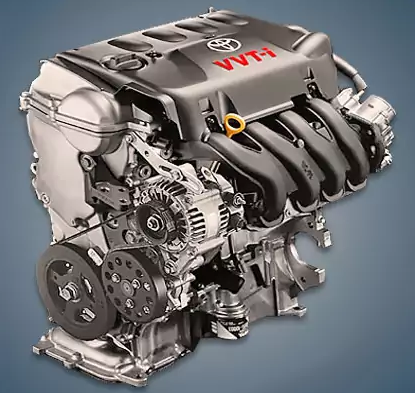
The engines 1NZ-FXE and 2NZ-FE are also part of the NZ family.
The company’s Japanese branch created this small motor. An aluminum cylinder block with cast-iron liners and an open cooling jacket, an aluminum 16-valve head, a timing chain drive, and a VVT-i type phase regulator at the inlet all strongly resembled the unit’s more voluminous counterpart with the 1ZZ-FE index. Hydraulic lifters were absent from the initial version, and the valves needed to be adjusted on a regular basis.
A slightly modified version of this motor, known as the “type 03,” debuted in 2003. Hydraulic lifters, an EGR valve, and a hotter thermostat set the unit apart. The Type 05 engine with the ETCS-i electronic throttle unit was first released in 2005. The Type 10 unit, which made its debut in 2010, stood out for its adaptation to stricter environmental regulations. There is some confusion because all of this engine’s modifications were made concurrently.
Specifications
| Production years | since 1999 |
| Displacement, cc | 1497 |
| Fuel system | injector |
| Power output, hp | 105 – 115 |
| Torque output, Nm | 130 – 145 |
| Cylinder block | aluminum R4 |
| Block head | aluminum 16v |
| Cylinder bore, mm | 75 |
| Piston stroke, mm | 84.7 |
| Compression ratio | 10.5 – 11.0 |
| Timing drive | chain |
| Phase regulator | VVT-i intake |
| Turbocharging | no |
| Recommended engine oil | 5W-20, 5W-30 |
| Engine oil capacity, liter | 3.7 |
| Fuel type | petrol |
| Euro standards | EURO 3/4 |
| Fuel consumption, L/100 km (for Toyota Corolla 2014) — city — highway — combined |
8.7 5.2 6.9 |
| Engine lifespan, km | ~200 000 |
| Weight, kg | 92 |
The engine was installed on:
- Toyota Allion 1 (T240), Allion 2 (T260), Auris 1 (E150), Auris 2 (E180), Corolla 9 (E120), Corolla E140, Corolla E160, Fun Cargo XP20, Porte 1 (NP10), Porte 2 (NP140), Probox 1 (XP50), Raum 2 (XZ20), Ractis 1 (XP100), Ractis 2 (XP120), Sienta 1 (XP80), Sienta 2 (XP170), Vios 1 (XP40), Vios 2 (XP90), Vios 3 (XP150), Yaris XP10, Yaris 2 (XP90), Yaris 3 (XP130);
- Scion xA XP60, xB XP30, xB E150;
- Geely CK, MK 1 (SC5);
- Great Wall Voleex C10.
Disadvantages of the 1NZ-FE engine
Oil consumption after 100,000 kilometers is this series’ most well-known issue. This can be caused by a variety of factors, such as the deterioration of valve stem seals, the development of piston rings, and the contamination of crater gas ventilation.
The timing drive’s resources are naturally limited because it uses a very thin roller chain with a link pitch of just 8 mm. Replacement is frequently necessary even before 100–120 thousand kilometers. The services recommend replacing them simultaneously because the VVT-i system has a slightly longer lifespan.
This unit needs high-quality fuel and oil to avoid soot overgrowth. Cleaning at floating engine speeds typically starts with the throttle assembly and the ISCV valve. If that doesn’t work, it’s worth flushing the crankcase ventilation valve and the MAF sensor.
This series of motors has many weak points, including hydraulic tensioners, valve covers, and the crankshaft rear oil seal, all of which are vulnerable to lubrication leaks.
Here, a low resource distinguishes an alternator belt, an oil pressure sensor, and engine mounts. Additionally, the majority of motor models lack hydraulic lifters.