
From 1989 to 2001, the company produced the 1.3-liter Toyota 4E-FE gasoline engine, which was used in many of the company’s vehicles but is most well-known for the Corolla model. This turbocharged power unit was modified and given the symbol 4E-FTE.
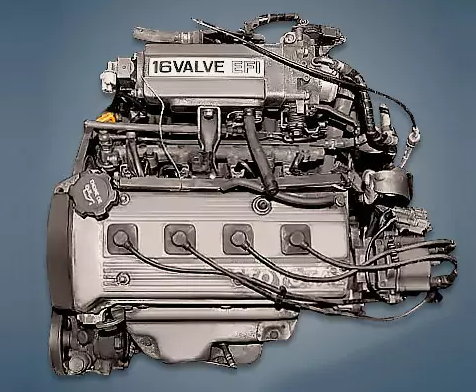
In 1989, this EFI type port fuel injection engine made its debut. The conventional design consists of a 16-valve aluminum cylinder head, a cast-iron in-line block for four cylinders, a timing belt that rotates one camshaft, and a gear connecting the second to the first. There are no hydraulic compensators, and valve clearances must be changed on a regular basis.
This motor has three generations in total: a sample from 1989, 1996, and 1997. However, their differences are negligible and mostly consist of improving the exhaust or intake.
The engines in the E 1.3 L family are 2E, 2E-E, 2E-TE, 4E-FE, and 4E-FTE.
The engine was mounted on:
- Toyota Corolla 7 (E100) in 1991 – 1998; Corolla 8 (E110) in 1995 – 2001;
- Toyota Cynos L40 in 1991 – 1995; Cynos L50 in 1995 – 1999;
- Toyota Starlet 4 (P80) in 1989 – 1995; Starlet 5 (P90) in 1989 – 1995;
- Toyota Tercel 4 (L40) in 1990 – 1994; Tercel 5 (L50) in 1994 – 1999.
Specifications
| Production years | 1989-2001 |
| Displacement, cc | 1331 |
| Fuel system | injector |
| Power output, hp | 80 – 100 |
| Torque output, Nm | 110 – 125 |
| Cylinder block | cast iron R4 |
| Block head | aluminum 16v |
| Cylinder bore, mm | 74 |
| Piston stroke, mm | 77.4 |
| Compression ratio | 9.6 |
| Hydraulic lifters | no |
| Timing drive | belt |
| Phase regulator | no |
| Turbocharging | no |
| Recommended engine oil | 5W-30 |
| Engine oil capacity, liter | 3.2 |
| Fuel type | petrol |
| Euro standards | EURO 2 |
| Fuel consumption, L/100 km (for Toyota Corolla 1998) — city — highway — combined |
7.7 5.1 6.8 |
| Engine lifespan, km | ~300 000 |
| Weight, kg | 105 |
Disadvantages of the Toyota 4E-FE engine
The cylinder head gasket frequently breaks in this unit due to its rapid overheating. Oil seals flow and tan even at high temperatures. Keep an eye on the cooling system.
It is not advised to fill this engine with low-quality gasoline because doing so will clog the fuel injectors, cover the throttle and idle valve with soot, and cause the engine to malfunction.
Oil consumption frequently manifests on a run of 120–150 thousand kilometers because of the presence of rings. Oil burn may result from the rapid deterioration of valve stem seals.
The timing belt is intended to last 100,000 kilometers, according to the manual, but it frequently extends even further. The fact that the valves typically do not bend when it jumps and breaks is a plus.
Like any old motor, it frequently worries about insignificant things like oil leaks, ignition system malfunctions, and certain sensors like a lambda probe. The valves require regular adjustment because there are no hydraulic compensators.