
The fourth and fifth generations of the Starlet model had the 1.3-liter Toyota 4E-FTE turbo engine installed in the rear of the P80 and P90, respectively. The engine was assembled at a Japanese factory between 1990 and 1999. Budget replacements for other Toyota vehicles frequently use this turbocharged engine.
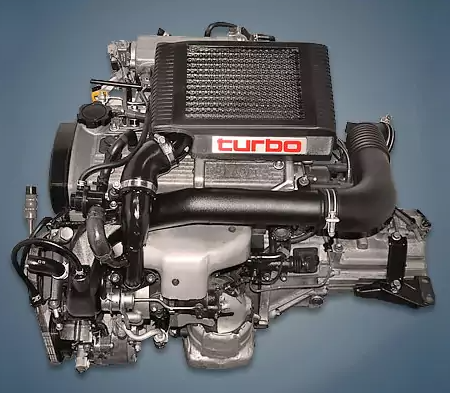
The engines in the E 1.3 L family are the 2E, 2E-E, 2E-TE, 4E-FE, and 4E-FTE.
The engine was mounted on:
- Toyota Starlet 4 (P80) in 1990 – 1995; Starlet 5 (P90) in 1996 – 1999.
Specifications
| Production years | 1990-1999 |
| Displacement, cc | 1331 |
| Fuel system | injector |
| Power output, hp | 135 |
| Torque output, Nm | 157 |
| Cylinder block | cast iron R4 |
| Block head | aluminum 16v |
| Cylinder bore, mm | 74 |
| Piston stroke, mm | 77.4 |
| Compression ratio | 8.2 |
| Features | DOHC, intercooler |
| Hydraulic lifters | no |
| Timing drive | belt |
| Phase regulator | no |
| Turbocharging | CT9 |
| Recommended engine oil | 5W-30 |
| Engine oil capacity, liter | 3.2 |
| Fuel type | petrol |
| Euro standards | EURO 2 |
| Fuel consumption, L/100 km (for Toyota Starlet 1997) — city — highway — combined |
10.1 6.4 7.9 |
| Engine lifespan, km | ~200 000 |
| Weight, kg | 115 |
Disadvantages of the 4E-FTE engine
If you adhere to its cooling system, this turbo engine’s dependability is not too bad;
Seals crack and flow here as a result of frequent overheating, puncturing the cylinder head gasket;
Idle speed frequently floats due to contamination of the throttle or idle speed controller channel;
Oil scraper rings may collapse and lubricant consumption may start to show after 100,000 kilometers;
This area lacks hydraulic lifters, and valve clearances need to be adjusted on a regular basis.