
From 2000 to 2009, the Japanese company produced the 2.0-liter Toyota 1AZ-FSE engine, which was fitted to numerous well-known company models, including the Caldina, Ipsum, RAV4, and Avensis. The exclusive D4 direct fuel injection system made this unit stand out from the others in the lineup.
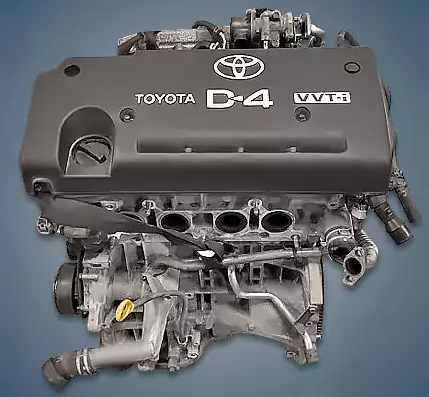
The engines 1AZ-FE, 2AZ-FE, 2AZ-FSE, and 2AZ-FXE are also part of the AZ family.
A direct fuel injection version of the 1AZ-FE engine debuted in 2000 alongside the standard model. It had its own piston and liquid oil cooler in addition to the exclusive D4 system. With an aluminum 4-cylinder block, cast-iron liners, a 16-valve head with two camshafts and no hydraulic lifters, a single-row timing chain, and a VVT-i variable valve timing system at the inlet, this engine is otherwise entirely traditional for the AZ series.
This motor underwent a minor update in 2004, and the so-called power unit type 04 was introduced. The primary distinction was the substitution of a mass air flow sensor for the absolute pressure sensor. The 1AZ-FSE got cylinder head bolts with longer threads in 2006, just like its siblings in the series.
The engine was mounted on:
- Toyota Allion 1 (T240) in 2001 – 2007;
- Toyota Avensis 1 (T220) in 2000 – 2002; Avensis 2 (T250) in 2003 – 2009;
- Toyota Avensis Verso 1 (XM20) in 2001 – 2009;
- Toyota Caldina 3 (T240) in 2002 – 2007;
- Toyota Gaia 1 (XM10) in 2001 – 2004;
- Toyota Ipsum 2 (XM20) in 2001 – 2009;
- Toyota Noah 1 (R60) in 2001 – 2007;
- Toyota Opa 1 (XT10) in 2000 – 2005;
- Toyota Premio 1 (T240) in 2001 – 2007;
- Toyota RAV4 2 (XA20) in 2000 – 2005; RAV4 3 (XA30) in 2005 – 2008;
- Toyota Voxy 1 (R60) in 2001 – 2007;
- Toyota Wish 1 (AE10) in 2003 – 2009.
Specifications
| Production years | 2000-2009 |
| Displacement, cc | 1998 |
| Fuel system | direct injection D4 |
| Power output, hp | 150 – 155 |
| Torque output, Nm | 190 – 200 |
| Cylinder block | aluminum R4 |
| Block head | aluminum 16v |
| Cylinder bore, mm | 86 |
| Piston stroke, mm | 86 |
| Compression ratio | 10.5 – 11 |
| Hydraulic lifters | no |
| Timing drive | chain |
| Phase regulator | VVT-i |
| Turbocharging | no |
| Recommended engine oil | 5W-20, 5W-30 |
| Engine oil capacity, liter | 4.2 |
| Fuel type | petrol |
| Euro standards | EURO 4 |
| Fuel consumption, L/100 km (for Toyota Avensis 2005) — city — highway — combined |
10.6 6.7 8.1 |
| Engine lifespan, km | ~300 000 |
| Weight, kg | 135 |
Disadvantages of the 1AZ-FSE engine
Mixing oil and antifreeze is a common problem for owners of AZ series engines. Everything was caused by the short-threaded head bolts, which were unable to support the weight. This issue has all but vanished since the manufacturer lengthened the thread in 2006.
Although the second generation D4 direct injection system is more dependable than the first, the requirements for fuel quality and filter replacement frequency remain the same. Additionally, when any sensor fails, this motor is susceptible to spontaneous vibrations.
Oil scraper rings typically result in lubrication consumption after 100,000 kilometers. By the way, oil burn is more common in updated engines made after 2006.
Up to 150,000 kilometers are frequently obtained using a phase control system and a single-row timing chain. The cold is crackling, twitching, and making mistakes because the gas distribution phases aren’t working properly.
This unit’s weak points are the water pump, the generator’s overrunning clutch, and the EGR valve, which causes soot to quickly overtake the engine. The plastic intake manifold vibrated at low speeds on the first-year motors. The choice of pushers controls the thermal clearances of the valves, and there are no hydraulic compensators.