
The company’s most well-known models, including the Harrier, Previa, RAV4, and Camry, were equipped with the 2.4-liter Toyota 2AZ-FE engine, which was manufactured in China, Japan, and the USA between 2000 and 2019. This series of units is well-known for having a cylinder head bolt thread breakdown issue.
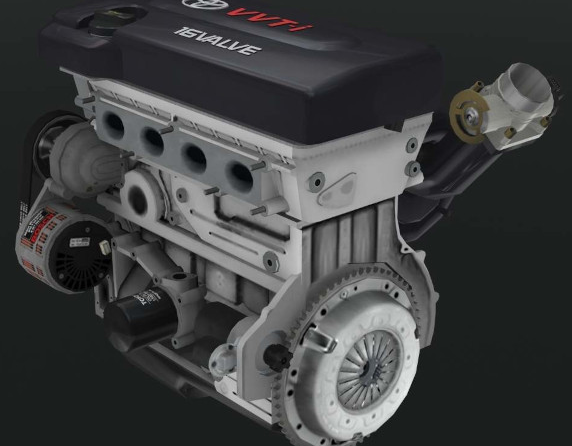
The engines 1AZ-FE, 1AZ-FSE, 2AZ-FSE, and 2AZ-FXE are also part of the AZ family.
This motor made its debut in 2000 and was put together in factories in the USA, China, and Japan. An aluminum block with cast-iron sleeves and an open cooling jacket, an aluminum 16-valve head without hydraulic lifters, and a timing chain drive with a variable valve timing system on the intake camshaft comprised the classic design of the time. This engine used a block of balance shafts, just like many engines larger than 2.0 liters.
The motor has undergone a few upgrades; in addition to the basic version type 00, there are types 03 and 06, which differ slightly in the environmental and engine electrical components. New block head bolts with a long thread of 30 mm were also added to the 2006 modification because the old bolts with a 24 mm thread frequently failed to stand up, which caused the cylinder head to fail. After 2008, versions have more power and a higher compression ratio (9.6 to 9.8).
Specifications
| Production years | 2000-2019 |
| Displacement, cc | 2362 |
| Fuel system | injector |
| Power output, hp | 145 – 170 |
| Torque output, Nm | 215 – 225 |
| Cylinder block | aluminum R4 |
| Block head | aluminum 16v |
| Cylinder bore, mm | 88.5 |
| Piston stroke, mm | 96 |
| Compression ratio | 9.6 – 9.8 |
| Hydraulic lifters | no |
| Timing drive | chain |
| Phase regulator | VVT-i |
| Turbocharging | no |
| Recommended engine oil | 5W-20, 5W-30 |
| Engine oil capacity, liter | 4.3 |
| Fuel type | petrol |
| Euro standards | EURO 3/4 |
| Fuel consumption, L/100 km (for Toyota Camry 2007) — city — highway — combined |
11.6 6.7 8.5 |
| Engine lifespan, km | ~350 000 |
| Weight, kg | 133 |
The engine was installed on:
- Toyota Alphard 1 (AH10) in 2002 – 2008; Alphard 2 (AH20) in 2008 – 2015;
- Toyota Camry 5 (XV30) in 2001 – 2006; Camry 6 (XV40) in 2006 – 2011;
- Toyota Harrier 1 (XU10) in 2000 – 2003; Harrier 2 (XU30) in 2003 – 2008;
- Toyota Highlander 1 (XU20) in 2000 – 2007;
- Toyota Ipsum 2 (XM20) in 2001 – 2009;
- Toyota Mark X ZiO 1 (NA10) in 2007 – 2013;
- Toyota Matrix 2 (E140) in 2009 – 2014;
- Toyota Previa 2 (XR30) in 2000 – 2005; Previa 3 (XR50) in 2006 – 2019;
- Toyota RAV4 2 (XA20) in 2003 – 2005; RAV4 3 (XA30) in 2005 – 2008;
- Toyota Solara 1 (XV20) in 2001 – 2003; Solara 2 (XV30) in 2003 – 2008;
- Scion xB E150 in 2007 – 2015;
- Scion tC AT10 in 2004 – 2010;
- Pontiac Vibe 2 in 2009 – 2010.
Disadvantages of the 2AZ-FE engine
The stripping of the block head bolt threads is the most well-known issue with these motors. An oil and antifreeze mixture resulted from the designers’ poor choice of length, which eventually caused a gap to form beneath the cylinder head. The thread size was raised to 30 mm in 2006.
During the initial years of production, the power units’ oil consumption was relatively moderate; however, following the 2006 update, it significantly increased and became the series’ hallmark. Oil scraper rings were typically the cause of lubricant consumption.
A thin chain, which is frequently extended to 150,000 kilometers, performs the timing drive. They are frequently replaced simultaneously, and the inlet phase regulator has a slightly longer lifespan.
These engines dislike prolonged low-speed driving, such as in congested areas. Cylinders in purely urban engines frequently form an ellipse up to 200,000 kilometers.
The overrunning clutch of the generator pulley, the water pump, the engine mounts, and the plastic gears of the balance shafts are all well-known for having low resources. In the early years of production, the plastic intake manifold made a lot of noise at low speeds. Additionally, this motor—especially the EGR valve in its Japanese versions—loves to coke.