
From 2005 to 2015, the 2.2-liter diesel Toyota 2AD-FHV or 2.2 D-CAT engine was put into European versions of the company’s well-known Avensis, Auris, and RAV4 models. The unit stood out due to its advanced Diesel Clean Advanced Technology exhaust cleaning system.
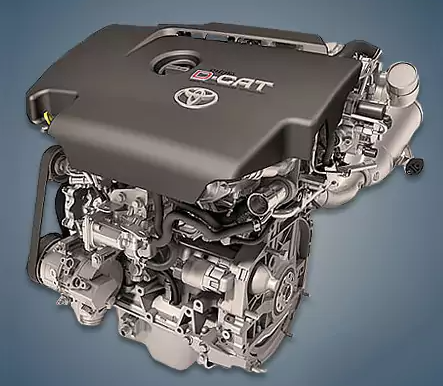
In 2005, a more potent variant was introduced alongside the 2AD-FTV diesel engine. In contrast to the traditional modification, this power unit had a more effective VGT liquid-cooled IHI turbocharger and piezo injectors installed right away. It was the same diesel engine in every other way, with an aluminum block and cast-iron liners, a timing chain drive, and a 16-valve aluminum block head with hydraulic lifters. Pressures of up to 2,000 bar were produced by Denso’s common rail fuel system with an HP3 injection pump. The block of balancing shafts that are typical of these motors was not overlooked by the designers.
The Diesel Clean Advanced Technology exhaust cleaning system was one of the unit’s features; it eliminated nitrogen oxides in addition to carbon monoxide and soot particles.
The diesel engines in the AD family are the 1AD FTV, 2AD FTV, and 2AD FHV.
The engine was mounted on:
- Toyota Avensis 2 (T250) in 2005 – 2009; Avensis 3 (T270) in 2009 – 2015;
- Toyota Auris 1 (E150) in 2006 – 2012;
- Toyota RAV4 3 (XA30) in 2008 – 2012; RAV4 4 (XA40) in 2012 – 2015;
- Lexus IS XE20 in 2005 – 2010.
Specifications
| Production years | 2005-2015 |
| Displacement, cc | 2231 |
| Fuel system | Common Rail |
| Power output, hp | 170 – 177 |
| Torque output, Nm | 380 – 400 |
| Cylinder block | aluminum R4 |
| Block head | aluminum 16v |
| Cylinder bore, mm | 86 |
| Piston stroke, mm | 96 |
| Compression ratio | 15.7 |
| Features | D-CAT |
| Hydraulic lifters | yes |
| Timing drive | chain |
| Turbocharging | yes |
| Recommended engine oil | 0W-30, 5W-30 |
| Engine oil capacity, liter | 6.5 |
| Fuel type | diesel |
| Euro standards | EURO 5 |
| Fuel consumption, L/100 km (for Toyota Avensis 2014) — city — highway — combined |
7.4 4.9 5.9 |
| Engine lifespan, km | ~250 000 |
| Weight, kg | 195 |
Disadvantages of the 2AD-FHV engine
First of all, engines from this line are notorious for frequent erosion of the mating surface of the aluminum cylinder block with a head and frequent cylinder head gasket breakdown.
The second-highest lubricant consumption occurs during the initial kilometers of the run. Initially, the manufacturer even replaced the pistons under warranty, but this was completely ineffective.
Servicemen advise replacing the washers beneath the nozzles about every 60,000 kilometers to prevent burnout. After that, disassembling the nozzles without causing damage becomes challenging.
All of these issues—rapid EGR valve contamination, soot-induced turbine geometry jamming, low piezo injector and SCV valve resources, frequent particulate filter regeneration failures, and nozzle failure—are common for contemporary diesel engines.