
Only the first two iterations of the Aristo sedan and the A80 Supra sports coupe were equipped with the Toyota 2JZ-GTE 3.0-liter twin-turbo engine, which the company produced from 1991 to 2002. There is a version with VVT-i, and the units for the Japanese market differ from those for export.
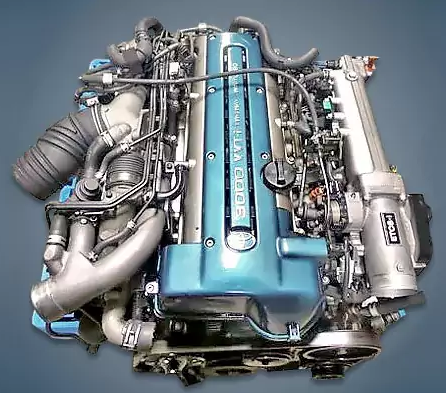
The primary distinction between the atmospheric and turbocharged versions of the 2JZ engine, which debuted in 1991, was the addition of two CT20 turbines with an intercooler for supercharging. The local Aristo sedan was the only vehicle with this motor installed at first, but the Supra A80, which was exported, was introduced in 1993. Her 2JZ was significantly more powerful and had CT12B turbos. The truth is that there was an unstated 280 horsepower cap on such units in the Japanese market. Nevertheless, it was unsuccessful in the USA and Europe, where the same engine produced between 325 and 330 horsepower.
The in-line cast-iron 6-cylinder block, a 24-valve aluminum head without hydraulic lifters, and a timing belt drive were all the same as the standard 2JZ. The only difference is that all turbo engines had an ignition system of the DIS-3 type without a distributor right away. Similar to its atmospheric counterpart, this unit was updated in 1997 at the intake with VVT-i.
The engines 1JZ-GE, 1JZ-GTE, 1JZ-FSE, 2JZ-GE, 2JZ-GTE, and 2JZ-FSE are also part of the JZ family.
The engine was mounted on:
- Toyota Aristo 1 (S140) in 1991 – 1997; Aristo 2 (S160) in 1997 – 2000;
- Toyota Supra 4 (A80) in 1993 – 2002.
Specifications
| Production years | 1991-2002 |
| Displacement, cc | 2997 |
| Fuel system | injector |
| Power output, hp | 275 – 330 (non VVT-i, 1991) 280 – 330 (VVT-i, 1997) |
| Torque output, Nm | 425 – 440 (non VVT-i, 1991) 450 – 455 (VVT-i, 1997) |
| Cylinder block | cast iron R6 |
| Block head | aluminum 24v |
| Cylinder bore, mm | 86 |
| Piston stroke, mm | 86 |
| Compression ratio | 8.5 |
| Hydraulic lifters | no |
| Timing drive | belt |
| Phase regulator | no VVT-i intake |
| Turbocharging | yes |
| Recommended engine oil | 5W-30, 5W-40 |
| Engine oil capacity, liter | 5.1 |
| Fuel type | petrol |
| Euro standards | EURO 2 (non VVT-i, 1991) EURO 3 (VVT-i, 1997) |
| Fuel consumption, L/100 km (for Toyota Supra 1995) — city — highway — combined |
15.5 9.6 12.2 |
| Engine lifespan, km | ~500 000 |
| Weight, kg | 270 |
Disadvantages of the 2JZ-GTE engine
This engine underwent several modifications that included turbines with ceramic impellers, which have a tendency to break apart and release their crumbs right into the combustion chamber. It is preferable to replace it with a metal one in order to prevent this from happening on any runs.
In contrast to the previous inline 6-cylinder engines, all attachments are supported by a single belt and tensioner, and it cannot withstand rough driving, including braking and acceleration.
The engine was equipped with a VVT-i phase control system at the intake following the 1997 update. Its dependability is poor, and after a run of up to 150,000 kilometers, it occasionally begins to crack.
A weak timing belt tensioner bracket, frequent camshaft oil seal leaks, and the unreliability of the pump and viscous coupling are some of the minor issues. The valve clearance needs to be changed because hydraulic lifters are not available here.