
From 1997 to 2009, a Canadian plant produced the 1.8-liter Toyota 1ZZ-FE engine, which was fitted to well-known Japanese company models like the Corolla, Matrix, and Avensis. A version of the ethanol power unit with the index 1ZZ-FBE is available for the Brazilian market.
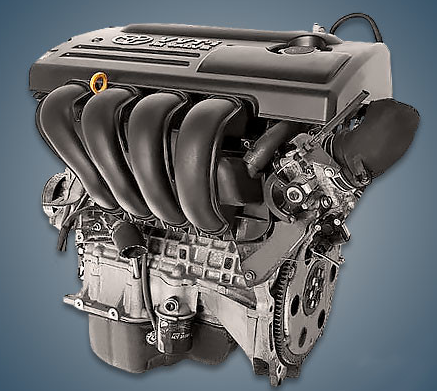
From 1997 to 2009, this engine was built in Canada for the American Corolla. The design was fairly standard: a 16-valve aluminum block head with two camshafts, a 4-cylinder aluminum block with cast-iron liners, and no hydraulic lifters. A chain was used for the timing drive, and in 1999 a phase regulator of the VVT-i type was installed at the inlet.
With an alloy block with a separate crankcase, a small long-stroke T-piston, and an open cooling jacket, engineers attempted to make the design as light as possible. Naturally, all of this restricts the power unit’s resources and does not improve its dependability.
From 1999 to 2007, the Toyota 1ZZ-FED engine was manufactured at the Shimoyama Plant for vehicles with a distinctly sporty personality, like the Celica or MR2. This unit had a different cylinder head with a larger intake cross section than the standard 1ZZ-FE.
The engines in the ZZ family are 1ZZ-FE, 1ZZ-FED, 2ZZ-GE, 3ZZ-FE, and 4ZZ-FE.
Specifications
| Production years | 1997-2009 |
| Displacement, cc | 1794 |
| Fuel system | injector |
| Power output, hp | 120 – 145 (1ZZ-FE) 140 (1ZZ-FED) |
| Torque output, Nm | 160 – 175 (1ZZ-FE) 170 (1ZZ-FED) |
| Cylinder block | aluminum R4 |
| Block head | aluminum 16v |
| Cylinder bore, mm | 79 |
| Piston stroke, mm | 91.5 |
| Compression ratio | 10.0 |
| Features | no |
| Hydraulic lifters | no |
| Timing drive | chain |
| Phase regulator | VVT-i |
| Turbocharging | no |
| Recommended engine oil | 5W-20, 5W-30 |
| Engine oil capacity, liter | 3.7 |
| Fuel type | petrol |
| Euro standards | EURO 3/4 |
| Fuel consumption, L/100 km (for Toyota Avensis 2005) — city — highway — combined |
9.4 5.8 7.2 |
| Engine lifespan, km | ~200 000 |
| Weight, kg | 130 (1ZZ-FE) 135 (1ZZ-FED) |
Frequent problems
A lot of oil is being consumed by the motor. The oil scraper rings, particularly those released prior to 2002, are the cause. Generally speaking, decarbonization does not address the issue.
Inside the unit, knock. After more than 150,000 kilometers, the timing chain has been loosened, which is crucial. It’s also possible that the belt tensioner is broken. In actuality, the valves don’t knock.
Turnovers fluctuated. At idle speed, flush the valve compartment and throttle-gate.
Vibrations. Maybe it’s the 1ZZ motor’s specificity, or maybe it’s the rear cushion.
Furthermore, the unit’s response to overheating is subpar. The cylinder block’s structure deteriorates as a result, necessitating its total replacement (liner and grinding are not officially carried out). Particularly with less than 200,000 kilometers of mileage, engine versions manufactured after 2005 have excellent performance characteristics.