
From 1982 until 1997, the company produced the 2.4-liter Toyota 22RE injection engine, which was fitted to passenger models like the Corona as well as SUVs and pickups like the Hilux and 4Runner. This motor underwent a significant update in 1985, and many aspects of the two versions of the device are incompatible.
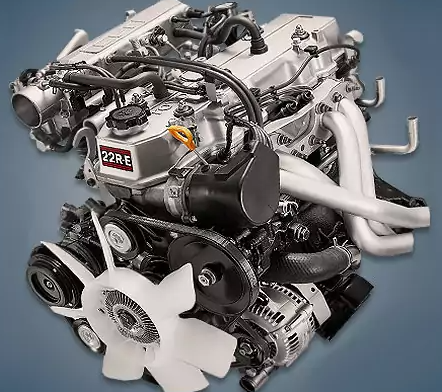
The 22R and 22R-TE engines are also part of the R family.
The engine was mounted on:
- Toyota 4Runner 1 (N60) in 1984 – 1989; 4Runner 2 (N120) in 1989 – 1995;
- Toyota Celica 3 (A60) in 1982 – 1985;
- Toyota Corona 7 (T140) in 1982 – 1987;
- Toyota Hilux 4 (N50) in 1983 – 1988; Hilux 5 (N80) in 1988 – 1997;
- Volkswagen Taro 1 (7A) in 1989 – 1997.
Specifications
| Production years | 1982-1997 |
| Displacement, cc | 2366 |
| Fuel system | injector |
| Power output, hp | 105 – 115 |
| Torque output, Nm | 185 – 190 |
| Cylinder block | cast iron R4 |
| Block head | aluminum 8v |
| Cylinder bore, mm | 92 |
| Piston stroke, mm | 89 |
| Compression ratio | 9.3 |
| Features | SOHC |
| Hydraulic lifters | no |
| Timing drive | chain |
| Phase regulator | no |
| Turbocharging | no |
| Recommended engine oil | 5W-30 |
| Engine oil capacity, liter | 4.5 |
| Fuel type | petrol |
| Euro standards | EURO 2 |
| Fuel consumption, L/100 km (for Toyota 4Runner 1992) — city — highway — combined |
18.0 9.9 13.8 |
| Engine lifespan, km | ~420 000 |
| Weight, kg | 155 |
Disadvantages of the Toyota 22R-E engine
Fuel consumption rises sharply when the vane-type mass fuel flow sensor malfunctions;
The old ignition system, particularly the distributor, is the source of many issues;
It is a very dependable engine with a huge resource of up to half a million kilometers; every 100,000 kilometers, valve adjustment is necessary because there are no hydraulic lifters here. Even before 150,000 kilometers, the timing chain can stretch and begin to make a lot of noise.