
Only the popular Camry sedan and its equivalents, the Windom and Lexus ES 300, were equipped with the 3.0-liter Toyota 3VZ-FE engine, which was manufactured at the company’s American facility between 1991 and 1996.
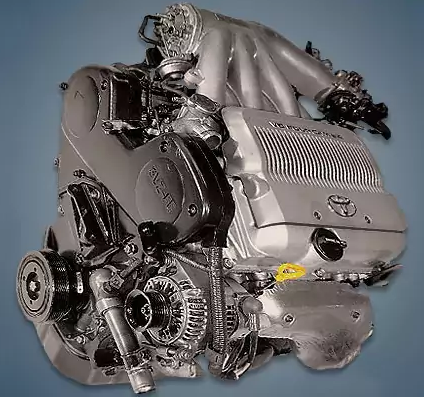
It is an overhead valve engine with two shafts. The chain provides the camshaft drive. Each cylinder has two intake and outlet valves. The intake valves are controlled by the left camshaft facing the vehicle, while the outlet valves are controlled by the right camshaft. Every 3VZ engine has an electronic fuel injection system installed.
This power unit was also available in a 12-valve version with a different index, 3VZ-E.
The engines in the VZ family are 1VZ-FE, 2VZ-FE, 4VZ-FE, 3VZ-FE, 3VZ-E, and 5VZ-FE.
The engine was mounted on:
- Toyota Camry 3 (XV10) in 1991 – 1996;
- Toyota Windom 1 (XV10) in 1991 – 1996;
- Lexus ES300 2 (XV10) in 1991 – 1994.
Specifications
| Production years | 1991-1996 |
| Displacement, cc | 2958 |
| Fuel system | MPI |
| Power output, hp | 185 |
| Torque output, Nm | 256 |
| Cylinder block | cast iron V6 |
| Block head | aluminum 24v |
| Cylinder bore, mm | 87.5 |
| Piston stroke, mm | 82 |
| Compression ratio | 9.6 |
| Features | ACIS |
| Hydraulic lifters | no |
| Timing drive | belt |
| Phase regulator | no |
| Turbocharging | no |
| Recommended engine oil | 5W-30 |
| Engine oil capacity, liter | 4.3 |
| Fuel type | petrol |
| Euro standards | EURO 1/2 |
| Fuel consumption, L/100 km (for Toyota Windom 1993) — city — highway — combined |
13.2 7.9 9.9 |
| Engine lifespan, km | ~250 000 |
| Weight, kg | 200 |
Disadvantages of the 3VZ-FE engine
The cylinder head frequently cracks as a result of gasket failure brought on by overheating.
An unreliable fan hydraulic drive is frequently the cause of overheating.
The primary connecting rod bearings and crankshaft journals are more worn.
Expensive spare parts and high fuel consumption are further drawbacks.
A progressive oil burn typically starts on runs exceeding 100,000 kilometers.