
The company’s American plant produced the 2.0-liter Toyota 1VZ-FE engine from 1988 to 1992, but it was only used in the two generations of the Camry sedan’s top-tier Prominent model. This power unit was manufactured for less than five years due to overheating issues.
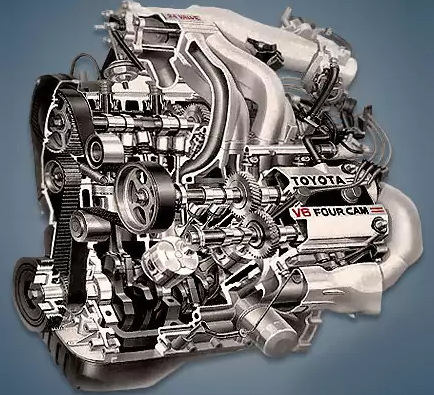
The engines in the VZ family are 1VZ-FE, 2VZ-FE, 4VZ-FE, 3VZ-FE, 3VZ-E, and 5VZ-FE.
The engine was mounted on:
- Toyota Camry 2 (V20) in 1988 – 1991;
- Toyota Camry V30 in 1990 – 1992.
Specifications
| Production years | 1988-1992 |
| Displacement, cc | 1992 |
| Fuel system | MPI |
| Power output, hp | 136 |
| Torque output, Nm | 173 |
| Cylinder block | cast iron V6 |
| Block head | aluminum 24v |
| Cylinder bore, mm | 78 |
| Piston stroke, mm | 69.5 |
| Compression ratio | 9.6 |
| Features | no |
| Hydraulic lifters | no |
| Timing drive | belt |
| Phase regulator | no |
| Turbocharging | no |
| Recommended engine oil | 5W-30 |
| Engine oil capacity, liter | 4.1 |
| Fuel type | petrol |
| Euro standards | EURO 1/2 |
| Fuel consumption, L/100 km (for Toyota Camry 1990) — city — highway — combined |
12.4 7.9 10.1 |
| Engine lifespan, km | ~250 000 |
| Weight, kg | 190 |
Disadvantages of the 1VZ-FE engine
The most well-known issue is gasket failure leading to cylinder head cracking.
Overheating is also frequently caused by the fan hydraulic drive’s poor dependability.
The crankshaft main journals and connecting rod bearings are experiencing increased wear.
Furthermore, replacement parts for this motor are not widely available and are excessively costly.
The high fuel and engine oil consumption is one of the remaining drawbacks.