
Only the well-liked Camry sedan and its Japanese equivalent, the Windom, were equipped with the 2.5-liter Toyota 4VZ-FE engine, which was produced at the company’s American facility between 1991 and 1996. The power unit was actually an improved version of the 2VZ-FE that came before it.
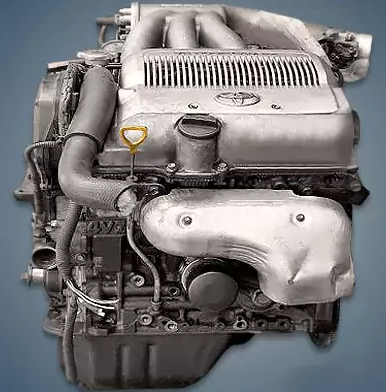
The engines in the VZ family are 1VZ-FE, 2VZ-FE, 4VZ-FE, 3VZ-FE, 3VZ-E, and 5VZ-FE.
The engine was mounted on:
- Toyota Camry V30 in 1991 – 1994;
- Toyota Windom 1 (XV10) in 1993 – 1996.
Specifications
| Production years | 1991-1996 |
| Displacement, cc | 2496 |
| Fuel system | MPI |
| Power output, hp | 173 |
| Torque output, Nm | 224 |
| Cylinder block | cast iron V6 |
| Block head | aluminum 24v |
| Cylinder bore, mm | 87.5 |
| Piston stroke, mm | 69.2 |
| Compression ratio | 9.6 |
| Features | no |
| Hydraulic lifters | no |
| Timing drive | belt |
| Phase regulator | no |
| Turbocharging | no |
| Recommended engine oil | 5W-30 |
| Engine oil capacity, liter | 4.0 |
| Fuel type | petrol |
| Euro standards | EURO 1/2 |
| Fuel consumption, L/100 km (for Toyota Windom 1993) — city — highway — combined |
12.6 8.7 10.9 |
| Engine lifespan, km | ~250 000 |
| Weight, kg | 195 |
Disadvantages of the 4VZ-FE engine
The cylinder head frequently cracked as a result of gasket failure and subsequent overheating; the failure of an unreliable fan hydraulic drive was frequently the cause of overheating; the crankshaft main journals and connecting rod bearings wear down more quickly;
Finding the necessary spare parts for repairs is difficult and costly;
Here, fuel consumption is excessive, and an oil burn typically starts after 100,000 kilometers.