
Large Hilux pickups, Fortuner and 4Runner SUVs, and Innova minivans all use the 2.5-liter Toyota 2KD-FTV engine, which has been manufactured at the company’s Japanese facility since 2001. An atmospheric version with 102 horsepower is available for simple modifications of pickups and minibuses.
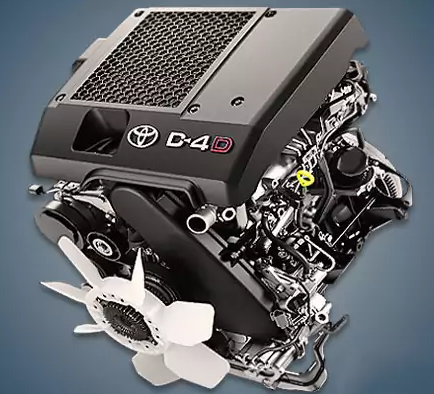
The engine was installed on:
- Toyota 4Runner 4 (N210) in 2002 – 2006;
- Toyota Fortuner AN60 in 2004 – 2015; Fortuner 2 (AN160) since 2015;
- Toyota Hilux 6 (N140) in 2001 – 2005; Hilux 7 (AN10) in 2005 – 2015; Hilux 8 (AN120) since 2015;
- Toyota Innova 1 (AN40) in 2004 – 2015; Innova 2 (AN140) since 2015.
Specifications
| Production years | since 2001 |
| Displacement, cc | 2494 |
| Fuel system | Common Rail Denso |
| Power output, hp | 120 – 142 |
| Torque output, Nm | 325 – 343 |
| Cylinder block | cast iron R4 |
| Block head | aluminum 16v |
| Cylinder bore, mm | 92 |
| Piston stroke, mm | 93.8 |
| Compression ratio | 17.4 – 18.5 |
| Features | intercooler |
| Hydraulic lifters | no |
| Timing drive | belt and gears |
| Phase regulator | VVT-i since 2013 |
| Turbocharging | normal and VNT |
| Recommended engine oil | 5W-30 |
| Engine oil capacity, liter | 6.9 |
| Fuel type | diesel |
| Euro standards | EURO 2/3/4 |
| Fuel consumption, L/100 km (for Toyota Hilux 2012) — city — highway — combined |
10.1 7.2 8.3 |
| Engine lifespan, km | ~300 000 |
| Weight, kg | 250 |
Disadvantages of the 2KD-FTV engine
Aluminum piston cracking was an issue before 2011.
Its nozzles can travel up to 100,000 kilometers and do not break down poor fuel.
After adjusting valve clearances, floating engine speeds typically disappear.
Because of coking and ring sticking, this engine is vulnerable to oil combustion.
Strong vibrations and excessive noise are complaints from many owners.