
From 1997 until 2003, the company produced the 1.0-liter Hyundai G4HC gasoline engine, which was used in the compact Atos and Atos Prime models, as well as their clones, Amica and Kia Visto. This engine came in two versions: one with a non-contact ignition system and the other with a traditional distributor.
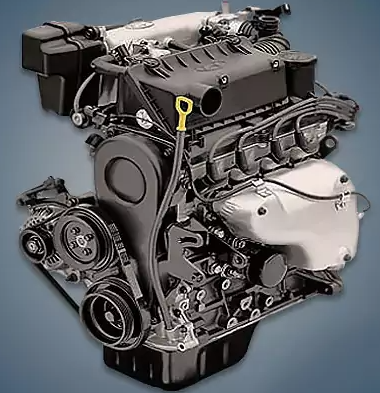
G3HA, G4HA, G4HC, G4HE, G4HD, and G4HG are members of the Epsilon family.
The engine was mounted on:
- Hyundai Atos 1 (MX) in 1997 – 2003.
Specifications
| Production years | 1997-2003 |
| Displacement, cc | 999 |
| Fuel system | distributed injection |
| Power output, hp | 54 (G4HC with distributor) 55 – 58 (G4HC-E with DLI) |
| Torque output, Nm | 73 (G4HC with distributor) 82 – 84 (G4HC-E with DLI) |
| Cylinder block | cast iron R4 |
| Block head | aluminum 12v |
| Cylinder bore, mm | 66 |
| Piston stroke, mm | 73 |
| Compression ratio | 9.5 (G4HC with distributor) 9.7 (G4HC-E with DLI) |
| Features | SOHC |
| Hydraulic lifters | no |
| Timing drive | belt |
| Phase regulator | no |
| Turbocharging | no |
| Recommended engine oil | 5W-40 |
| Engine oil capacity, liter | 3.1 |
| Fuel type | petrol |
| Euro standards | EURO 2 (G4HC with distributor) EURO 3 (G4HC-E with DLI) |
| Fuel consumption, L/100 km (for Hyundai Atos 2000) — city — highway — combined |
8.0 5.4 6.3 |
| Engine lifespan, km | ~200 000 |
| Weight, kg | 83.9 |
Disadvantages of the Hyundai G4HC engine
Although this engine isn’t particularly inventive, it has no significant reliability issues;
Contamination of the throttle or idle speed controller is the primary cause of floating engine speed;
Additionally, the motor simply begins to triple when the wiring’s insulation cracks;
The alternator belt must be modified because of the weak tension; closer to 200,000 km, the unit requires capital because there are repair dimensions.