
The 2.0-liter Hyundai Kia G4CP engine, which was essentially a copy of the Mitsubishi 4G63, was manufactured in Korea under license between 1988 and 2003. The Grandeur, Sonata, and Joice all had such a unit installed. The motor was manufactured in two versions: one for eight valves and the other for sixteen, with the latter having its own index, G4CP-D or G4DP.
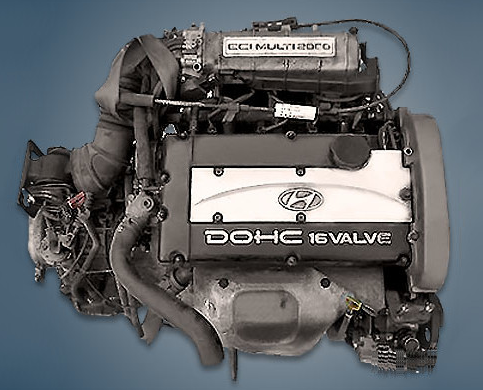
Sirius family: G4CR (1.6 L); G4CN, G4CM, G4JN (1.8 L); G4CP, G4JP (2.0 L); G4JS, G4CS (2.4 L).
The engine was mounted on:
- Hyundai Grandeur 1 (L) in 1986 – 1992; Grandeur 2 (LX) in 1992 – 1998;
- Hyundai Sonata 2 (Y2) in 1988 – 1993; Sonata 3 (Y3) in 1993 – 1998;
- Kia Joice 1 (RS) in 1999 – 2003.
Specifications
| Production years | 1988-2003 |
| Displacement, cc | 1997 |
| Fuel system | injector |
| Power output, hp | 95 – 105 (version 8v) 125 – 145 (version 16v) |
| Torque output, Nm | 155 – 165 (version 8v) 165 – 190 (version 16v) |
| Cylinder block | cast iron R4 |
| Block head | aluminum 8v aluminum 16v |
| Cylinder bore, mm | 85 |
| Piston stroke, mm | 88 |
| Compression ratio | 8.5 – 8.6 (version 8v) 9.0 (version 16v) |
| Features | no |
| Hydraulic lifters | yes |
| Timing drive | belt |
| Phase regulator | no |
| Turbocharging | no |
| Recommended engine oil | 10W-40 |
| Engine oil capacity, liter | 4.0 |
| Fuel type | petrol |
| Euro standards | EURO 1/2 |
| Fuel consumption, L/100 km (for Kia Joice 2002) — city — highway — combined |
13.4 7.5 9.7 |
| Engine lifespan, km | ~300 000 |
| Weight, kg | 154.5 (without attachments) |
Disadvantages of the Hyundai G4CP engine
The timing belt and balancer belt’s low resources are linked to the engine’s primary issues.
When any of these belts break, valves and pistons typically collide.
Hydraulic lifters can travel up to 100,000 kilometers and dislike poor oil.
Throttle contamination frequently causes floating idle speeds.
The exhaust manifold frequently cracks, and the engine mounts are still in use.