
Due to its structural similarity to the Mitsubishi 4G63 power unit, the 2.0-liter Hyundai G4JP engine was manufactured under license at a plant in South Korea between 1998 and 2011.
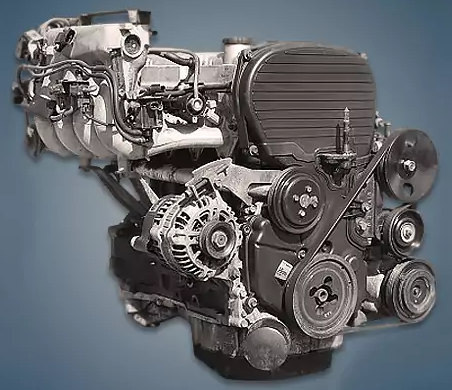
An upgraded 16-valve G4CP-D engine, which was based on the well-liked Mitsubishi 4G63 engine, was introduced by Hyundai in 1998. This includes a timing belt drive and balancer shaft unit, an aluminum 16-valve head with hydraulic lifters, MPi distributed fuel injection, and a cast-iron cylinder block.
The upgraded engine differs greatly from the G4CP-D engine in that it has its own oil pump, thermostat, pump, control unit, intake and exhaust manifolds, a lightweight connecting rod and piston group, and slightly different crankshafts and camshafts.
Sirius family: G4CR (1.6 L); G4CN, G4CM, G4JN (1.8 L); G4CP, G4JP (2.0 L); G4JS, G4CS (2.4 L).
The engine was mounted on:
- Hyundai Santa Fe 1 (SM) in 2000 – 2006;
- Hyundai Sonata 4 (EF) in 1998 – 2011;
- Hyundai Trajet 1 (FO) in 1999 – 2004;
- Kia Magentis 1 (GD) in 2000 – 2006.
Specifications
| Production years | 1998-2011 |
| Displacement, cc | 1997 |
| Fuel system | distributed injection |
| Power output, hp | 130 – 140 |
| Torque output, Nm | 175 – 185 |
| Cylinder block | cast iron R4 |
| Block head | aluminum 16v |
| Cylinder bore, mm | 85 |
| Piston stroke, mm | 88 |
| Compression ratio | 10.0 |
| Hydraulic lifters | yes |
| Timing drive | belt |
| Turbocharging | no |
| Recommended engine oil | 5W-30, 5W-40 |
| Engine oil capacity, liter | 4.5 |
| Fuel type | petrol |
| Euro standards | EURO 2/3 |
| Fuel consumption, L/100 km (for Hyundai Sonata 2003) — city — highway — combined |
12.4 7.1 9.0 |
| Engine lifespan, km | ~450 000 |
| Weight, kg | 150.8 (without attachments) |
Disadvantages of the Hyundai G4JP engine
This device is very particular about the oil’s quality and, in particular, when it should be changed. A wedge of balance shaft bearings and a break in their belt, which falls directly beneath the timing belt and also breaks, are common outcomes of cutting lubrication. All of this results in fatal head injuries in addition to the bending of the valves.
Strong engine vibrations are a common complaint from owners of vehicles with this engine. In addition to balance shafts, unreliable unit supports may also be the culprits.
Here, the resource of hydraulic lifters is significantly impacted by the use of low-quality oil. At 50,000 kilometers, they may occasionally malfunction and begin to knock loudly.
Here, contamination of the throttle or idle speed controller frequently results in floating speeds, and after 200–250 thousand kilometers, rings frequently lie and oil consumption shows up.